Decluttering
Decluttering a Loft or Attic Safely
How do I safely clear a loft?
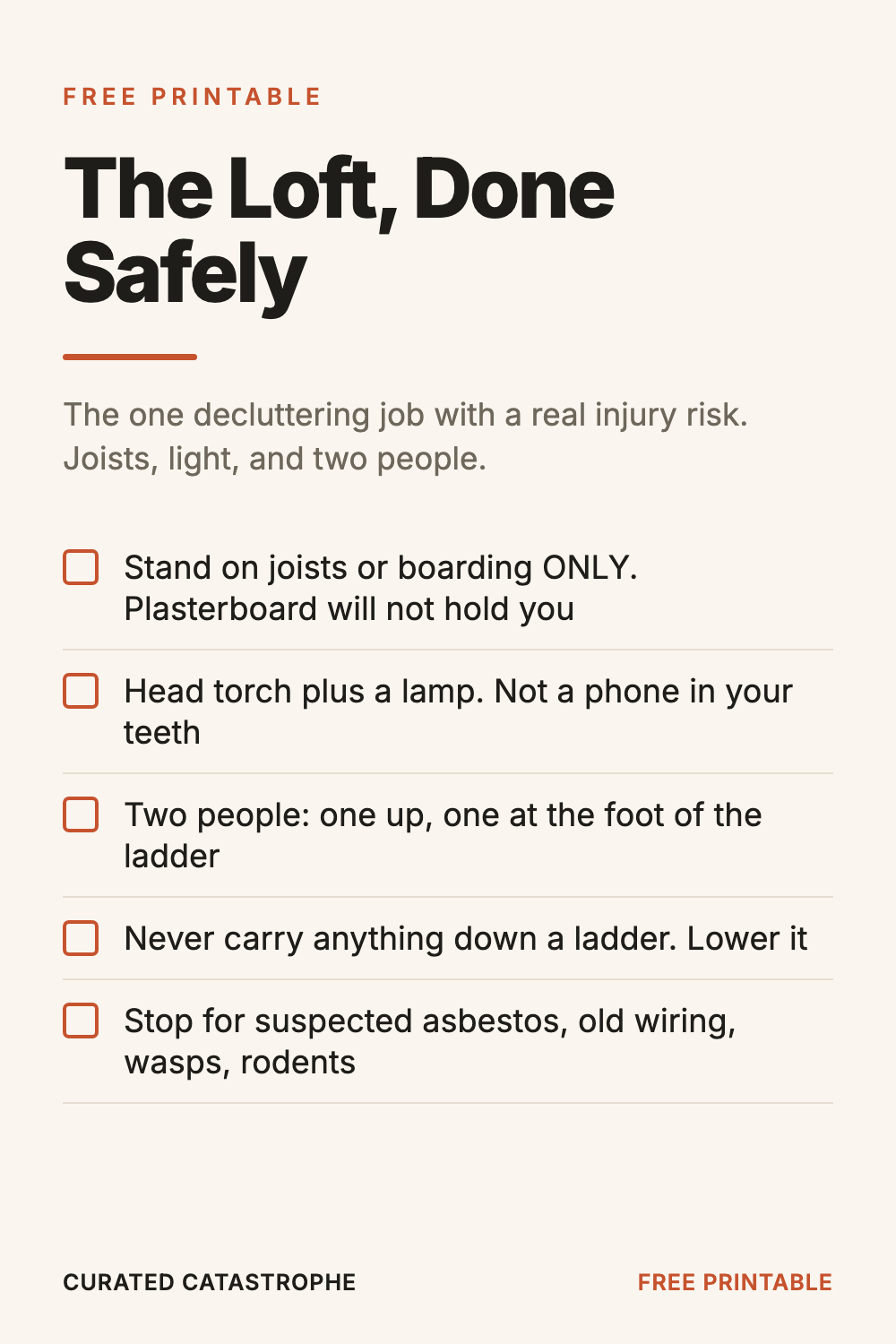
Stand only on joists or boarding, because plasterboard will not hold you. Use a head torch and a lamp, work with a second person at the foot of the ladder, and never carry anything down a ladder. Stop if you find suspected asbestos, old wiring or signs of pests.
Lofts are where things go to be forgotten, which makes them the highest-yield decluttering job in most houses. They are also the only one where people get hurt.
Falls through ceilings, falls from ladders, disturbed insulation, and in older houses asbestos and old wiring. None of that is a reason to avoid it, but it is a reason to do it deliberately rather than climbing up on a whim.
The safety part, first
Only stand on the joists or on boarding. The plasterboard between joists will not hold you and a foot through a ceiling is the most common loft injury by a long way.
- Light before anything else. A head torch plus a lamp, not a phone in your teeth
- Two people, always. One up, one at the bottom of the ladder taking things down
- Never carry anything down a ladder. Lower it, or drop soft things onto a sheet below
- Proper footwear, not socks and not flip flops
- Check the ladder catches before you put weight on it
Stop and get advice if you find: loose grey fibrous board or lagging that might be asbestos (common pre-1980s, do not disturb it), old fabric-covered wiring, wasp nests, or signs of rodents. None of those are DIY problems.
Do it in the right weather
Lofts are brutally hot in summer and freezing in winter, and both make people rush.
A mild day, morning rather than afternoon, working in short stints. Rushing in a loft is how the safety rules get skipped.
The one-hour rule
Do not attempt the whole loft. Bring down what you can handle in an hour and sort it downstairs, where there is light, space and somewhere to put things.
Sorting in the loft is the mistake. You cannot see, you cannot stand properly, and you will make poor decisions because you are uncomfortable and want it over with.
What is actually up there
Predictable, in most houses, and worth knowing because it makes the decisions faster.
- Boxes from a previous move, unopened. If you have not needed it since the last move, that is the answer, and it is the same test used when decluttering before a move
- Baby and children's things, kept for a next child who is now grown
- Appliance boxes past their warranty
- Old paperwork, most of it past any retention period
- Broken furniture kept for a repair that will not happen
- Genuinely sentimental things, which is the one category to slow down for
What should never be stored in a loft
Some of what is up there has already been ruined and people do not know it yet.
- Photographs, negatives, papers. Heat and damp destroy them, and this is the most commonly regretted loss
- Candles, vinyl records, anything wax or plastic that warps
- Electronics. Temperature cycling and condensation kill them
- Fabric that matters, unless in sealed containers. Wool especially, because of moths
- Anything you will want in a hurry
- Liquids, which freeze, expand and split
Check the sentimental boxes for damage while you are up there. Finding a ruined photo album is grim, and finding it now beats finding it in ten years.
Store the rest properly
- Clear plastic boxes with lids, never cardboard. Cardboard absorbs damp, collapses under stacking, and is what mice nest in
- Label the side, not the lid, because stacked boxes hide their lids
- Heavy boxes near the hatch, so nobody carries weight across joists
- Do not compress the insulation. Boxes sitting directly on it destroy its performance and cost you money every winter. Board over the joists properly, or store elsewhere
- A written list of what is up there, kept downstairs. Nobody remembers, and this alone prevents most future trips
The honest question
For each box: if this had been thrown away five years ago without telling me, would I have noticed?
For most loft contents the honest answer is no, and that is the whole decision. The loft is where things go when nobody wanted to decide, so the deciding is all that is left to do.
What helps
- A head torch, so both hands are free on a ladder.
- Clear stackable boxes with clip lids, which survive a loft where cardboard does not.
- A loft ladder with a handrail, if yours does not have one.
- Vacuum bags for textiles, sealed against moths and damp.
- A written inventory kept downstairs, which saves more trips than anything else on this list.
What actually helps
- A head torch
Both hands free, which matters on a ladder.
- Clear clip-lid boxes
They survive a loft. Cardboard does not.
- Vacuum bags for textiles
Sealed against moths and damp, for synthetics only.
Common questions
How do I safely clear a loft?
Stand only on joists or boarding, because plasterboard will not hold you. Use a head torch and a lamp, work with a second person at the foot of the ladder, and never carry anything down a ladder. Stop if you find suspected asbestos, old wiring or signs of pests.
What should you not store in a loft?
Photographs, negatives and papers, which heat and damp destroy; candles, vinyl and anything that warps; electronics, which condensation kills; fabric that matters unless sealed against moths; liquids, which freeze and split; and anything you might want in a hurry.
Is it bad to store boxes on loft insulation?
Yes. Compressing insulation destroys its performance and costs you money every winter. Board over the joists properly so boxes sit on the boarding, or store the items somewhere else.
The Loft, Done Safely
The one decluttering job with a real injury risk. Joists, light, and two people.
Download the free PDFSave this for later
Rather not decide?
Should I keep this? answers it for one object in four questions.
Keep reading
- Decluttering
Decluttering Before a Move: What Not to Pack
Every box you do not pack is one you do not carry, pay for, or unpack. The order that makes that easy rather than agonising.
- Decluttering
Decluttering Sentimental Items Without Regret
The rules that work everywhere else fail here. Sentimental things need editing rather than culling, and a different set of questions.
- Decluttering
Decluttering Someone Else's Things Without a Row
You cannot declutter another adult. What you can do is negotiate space, and there is a real difference.