Decluttering
Decluttering Before a Move: What Not to Pack
What should I get rid of before moving house?
Anything expired, half-used cleaning products, anything broken you meant to fix, furniture that will not fit the new place, duplicate kitchen items, paperwork past its retention date, and anything you have not unpacked since the last move. A box costs you three times: packing, moving and unpacking.
Moving is the only time most people handle every single object they own, one at a time, with a deadline attached.
That makes it the best decluttering opportunity you will ever get, and also the worst possible moment to be making careful decisions. So the trick is not to decide better. It is to decide less, by sorting into categories where the answer is obvious.
The arithmetic that makes this easy
Removal firms charge by volume or by weight. Every box you do not pack is one you do not pay to move, do not carry down a staircase, and do not unpack at the other end while exhausted.
A box costs you three times: once packing, once moving, once unpacking. That is the whole argument, and it is why moving-day decluttering pays better than any other kind.
If you would not pay somebody to carry it up the stairs of the new place, do not put it in a box. That is the only test you need for about eighty per cent of what you own.
Do not pack these, at all
Straightforward categories where the answer never varies. No agonising required.
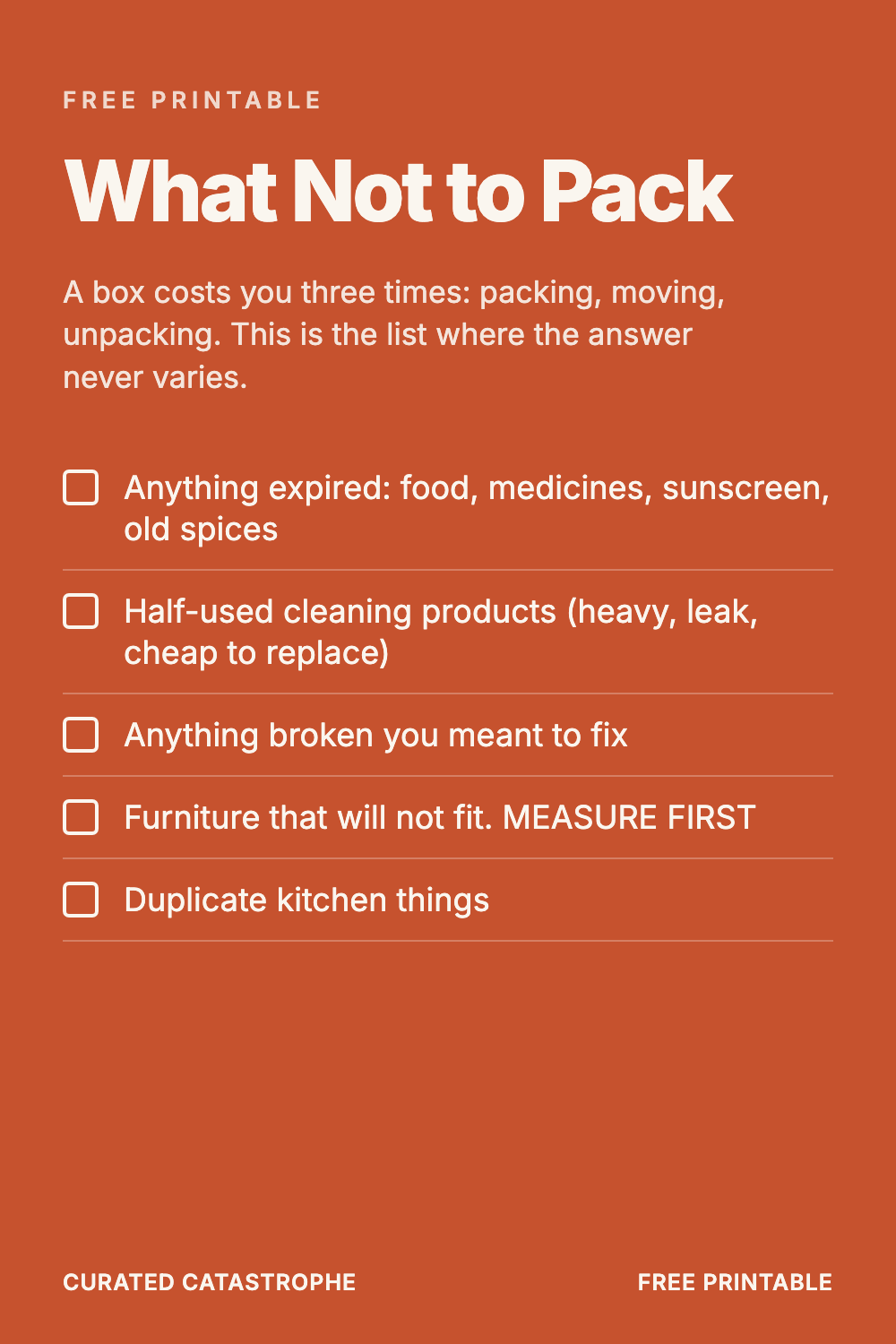
- Anything expired: food, medicines, sunscreen, spices older than about two years
- Half-used cleaning products, which leak, are heavy, and cost almost nothing to replace
- Anything broken you meant to fix. The new house will not fix it either
- Furniture that will not fit. Measure first. People move sofas that cannot enter the new room
- Duplicate kitchen things: you do not need eleven mugs at the other end
- Paperwork past its retention date, which is most of it. See what to keep and shred
- **Anything you have not unpacked since the last move.** This one is decisive and people know exactly which boxes those are
The four-week order
Start at the edges and work in. Doing it in this order means you are never decluttering a room you still need to live in.
- Four weeks out: storage. Loft, garage, shed, under the beds. Nothing here is in daily use, so nothing here is a difficult decision. This is also where the volume is.
- Three weeks out: duplicates and off-season. Spare bedding, out-of-season clothes, the second set of everything.
- Two weeks out: books, decor, hobbies. The slow-to-decide categories, done when the easy volume has already gone and you can see the difference.
- One week out: the daily-use rooms. Kitchen and bathroom last, because you need them working until the end.
Selling: be realistic about time
Selling things takes longer than people plan for, and unsold items become a panic on the last day.
Set a hard cutoff two weeks before the move. Anything unsold by then gets donated, not relisted. The money you might get is rarely worth the last-week stress, and this is the single most common place a moving declutter falls apart.
The "maybe" box problem
You will end up with things you genuinely cannot decide about under time pressure. That is normal and it is not failure.
One box, sealed, dated, labelled with the room it came from. Put it somewhere accessible at the new place. If it is unopened in six months, it goes without being opened, which is the same box-it-with-a-date approach the rest of the site uses.
Allow yourself one or two of these. Ten means you are using it to avoid deciding.
Pack the first night box first
Not decluttering, but it prevents the worst evening of the whole process.
One box, clearly marked, packed first and loaded last: kettle, mugs, tea, loo roll, hand soap, a towel each, phone chargers, medication, bedding, and a change of clothes. Anyone who has moved without one only forgets to do it once.
At the other end
Unpack the kitchen and one bedroom completely, then stop and live in it for a week before deciding where anything else goes.
Storage decisions made on day one are made with no information about how you actually use the new house. A week of living there tells you more than an afternoon of planning, and it stops you building the same clutter patterns you just escaped.
What helps
- A roll of coloured tape per room, which is faster than writing on every box.
- Vacuum bags for bedding and coats, since volume is what you are paying for.
- A dedicated "first night" box in a colour nothing else uses.
- A tape measure used before the move, not after, which is the difference between a sofa that fits and a sofa on the pavement.
What actually helps
- Coloured tape, one roll per room
Faster than writing on every box, and readable across a room.
- Vacuum bags for bedding and coats
Volume is what you are paying to move.
- A tape measure
Used before the move, which is the difference between a sofa that fits and one on the pavement.
Common questions
What should I get rid of before moving house?
Anything expired, half-used cleaning products, anything broken you meant to fix, furniture that will not fit the new place, duplicate kitchen items, paperwork past its retention date, and anything you have not unpacked since the last move. A box costs you three times: packing, moving and unpacking.
When should I start decluttering before a move?
Four weeks out, starting at the edges: loft, garage and under the beds first, because nothing there is in daily use so nothing there is a hard decision. Then duplicates and off-season, then books and hobbies, and the kitchen and bathroom last because you need them working.
Is it worth selling things before a move?
Only for high value, easy postage or genuine collectability. For everything else you are working for about two pounds an hour. Set a hard cutoff two weeks before the move, and anything unsold by then gets donated rather than relisted.
What Not to Pack
A box costs you three times: packing, moving, unpacking. This is the list where the answer never varies.
Download the free PDFSave this for later
Rather not decide?
Should I keep this? answers it for one object in four questions.
Keep reading
- Decluttering
Christmas Decoration Storage That Makes Next December Easy
Everything that goes wrong in December was decided in January, in a hurry, by someone who wanted it over with.
- Decluttering
Decluttering Sentimental Items Without Regret
The rules that work everywhere else fail here. Sentimental things need editing rather than culling, and a different set of questions.
- Decluttering
Decluttering Someone Else's Things Without a Row
You cannot declutter another adult. What you can do is negotiate space, and there is a real difference.