Decluttering
Decluttering Sentimental Items Without Regret
How do I declutter sentimental items?
Edit rather than cull. Reduce each category to its best representative: three drawings rather than twenty, two cups from the dinner service rather than all of it. The usual tests fail here because sentimental objects earn their space through meaning rather than use.
Every decluttering method eventually hits the box of sentimental things and stops working.
"Have you used it in a year" is meaningless for a christening gown. "Could you replace it" is cruel for a letter. The standard questions are built for objects with a function, and these objects do not have one.
So they need different questions, and a different goal. You are not culling this box. You are editing it.
Why the usual rules fail
The normal tests ask whether an object earns its space through use. Sentimental objects earn their space through meaning, which is not a thing you can measure by frequency.
Applying the wrong test produces one of two bad outcomes: you keep everything because nothing passes, or you get ruthless and later regret it. Both are common and both come from the same mistake.
The goal is not less. The goal is that the things you kept are findable, visible and known, instead of being three unopened boxes in a loft that nobody has looked in since 2011.
The three questions that do work
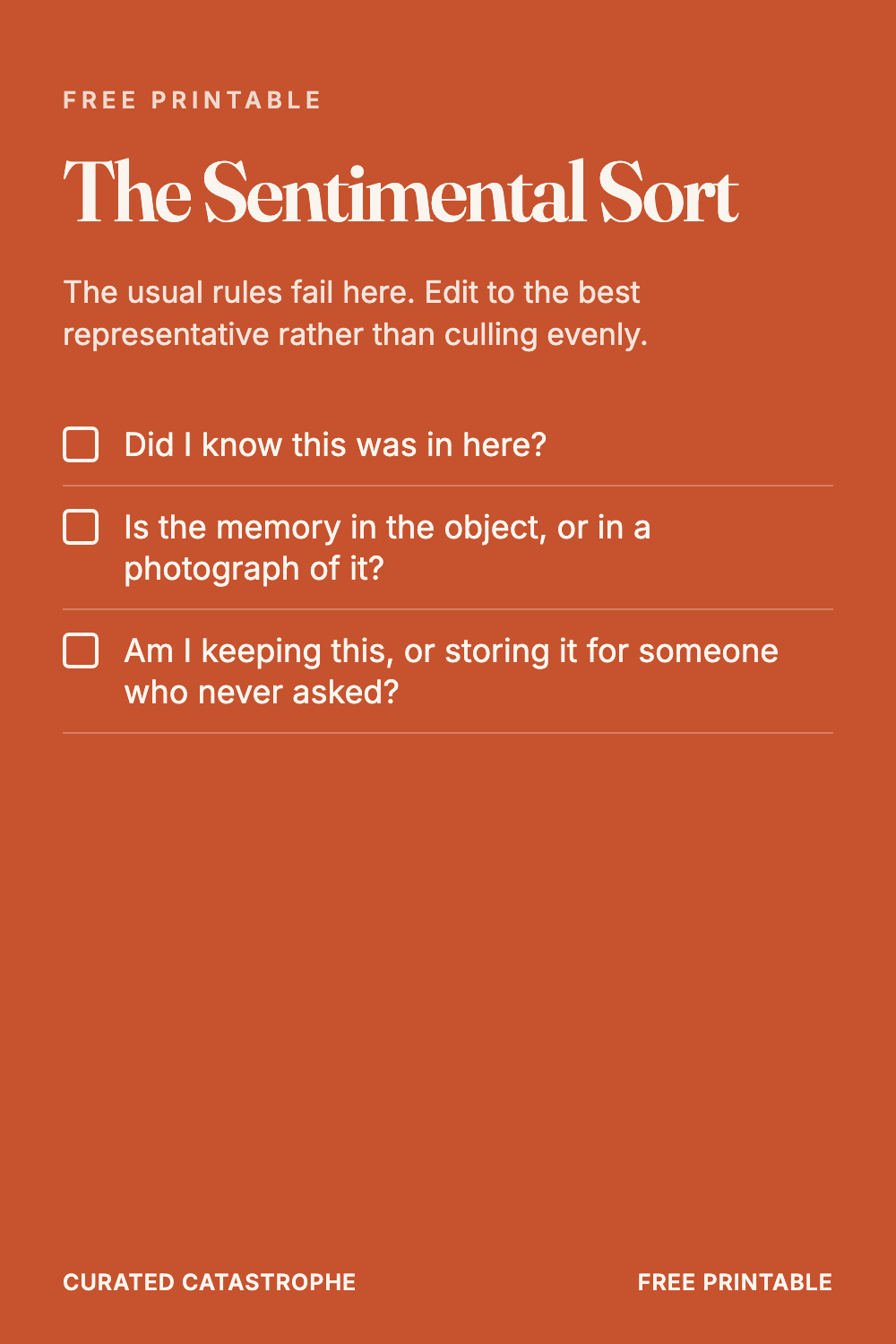
- Do I know this is in here? If you could not have listed it, it is not currently doing the job of a memento. This is the single most useful question on the page.
- Is the memory in the object, or in a photograph of the object? For most things the answer is the photograph, and that is not a betrayal of anything.
- Am I keeping this, or am I storing it for someone who has not asked for it? Especially relevant for children's things and inherited things.
Edit, do not cull
The method is to reduce a category to its best representative rather than to thin it evenly.
- Twenty of a child's drawings becomes the three best, framed or in a folder you open
- A whole dinner service from a grandparent becomes two cups you actually use
- Forty concert tickets becomes one page of them in a frame
- Every school report becomes the one with the funny comment
One thing, visible and used, beats forty things in a box. That is the trade, and stated plainly most people find it easy to agree with.
Photograph the rest, properly
Not a blurry snap on a kitchen worktop. That is why people do not trust the photograph rule.
Take it in daylight, against a plain wall or a sheet, straight on. Put the photos in one album on your phone or in a printed book, named something you will search for. A photo book of a child's artwork gets looked at far more often than the artwork in the loft ever does.
The things you should not decide today
There is a real category here, and pretending otherwise is how people get hurt.
If somebody died in the last year or so, this is not the moment. Grief makes both directions worse: you will either keep everything out of fear or clear it out in one afternoon and regret it.
Put it in one clearly labelled box, put the box somewhere dry, and set a date a year out. That is a decision, not an avoidance. The "box it with a date" approach exists exactly for this.
Other people's sentimental things
You do not get to decide these, even when they are in your house and even when they are objectively rubbish.
What you can do is set a container: this shelf, this box, this much space. Boundaries about volume are reasonable and boundaries about content are not, and that distinction prevents most household arguments about clutter.
The display test
The strongest argument for editing is this: what survives should be somewhere you see it.
A shelf, a frame, a bowl of things by the door. If everything sentimental you own is in storage, you have all of the cost of keeping it and none of the benefit, which is the worst available outcome and the most common one.
What helps
- One archival box per person, acid-free if papers are involved, so the limit is physical.
- A photo book service, which is what makes the photograph rule actually work.
- Simple frames in one size, so displaying something is a five-minute job not a project.
- A document scanner app, for letters and cards where the words matter and the paper does not.
What actually helps
- An archival storage box
One per person, so the limit is physical rather than a matter of willpower.
- Simple frames in one size
Displaying something becomes a five-minute job rather than a project.
- A photo book service
What makes the photograph rule actually work.
Common questions
How do I declutter sentimental items?
Edit rather than cull. Reduce each category to its best representative: three drawings rather than twenty, two cups from the dinner service rather than all of it. The usual tests fail here because sentimental objects earn their space through meaning rather than use.
Is it okay to photograph sentimental items and let them go?
Yes, and for most things the memory is genuinely in the photograph rather than the object. Do it properly though: daylight, plain background, straight on, in one named album or a printed book. A photo book gets looked at far more often than a box in a loft ever does.
Should I declutter after someone dies?
Not in the first year. Grief pushes people to extremes in both directions, keeping everything out of fear or clearing it in an afternoon and regretting it. Put it in one labelled box somewhere dry and set a date a year out. That is a decision rather than avoidance.
The Sentimental Sort
The usual rules fail here. Edit to the best representative rather than culling evenly.
Download the free PDFSave this for later
Rather not decide?
Should I keep this? answers it for one object in four questions.
Keep reading
- Decluttering
Decluttering Someone Else's Things Without a Row
You cannot declutter another adult. What you can do is negotiate space, and there is a real difference.
- Decluttering
Decluttering Before a Move: What Not to Pack
Every box you do not pack is one you do not carry, pay for, or unpack. The order that makes that easy rather than agonising.
- Decluttering
How to Declutter Your Whole House Without Losing a Weekend
A room-by-room decluttering plan in 30-minute sessions, with a decision rule that stops you putting everything back.