Decluttering
How to Declutter Your Whole House Without Losing a Weekend
Where should you start when decluttering a whole house?
The bathroom cabinet. It is almost entirely expiry dates with no emotional weight, so it builds momentum before you reach anything difficult. Sentimental items come last, and never in the first month.
Decluttering advice usually fails at the same point: you pull everything out, get overwhelmed somewhere around the third bin bag, and put most of it back. The house looks worse than when you started and you conclude you are the problem.
You are not. The method is. Emptying an entire room before you have decided anything is a guaranteed way to run out of steam at the exact moment the mess is at its peak.
This plan works in 30-minute sessions, one small area at a time, with a decision rule you apply before you touch anything.
The rule: decide the category, not the object
The reason decluttering is exhausting is that you are making hundreds of individual decisions, and every one of them is slightly emotional. It is decision fatigue, not laziness.
So decide once, at category level, before you start:
"I keep one set of bed linen per bed plus one spare." Not: "do I keep this particular sheet?"
Set the rule, then apply it mechanically. You will get through four times as much, and you will not have to relitigate every object.
The four-box method, with one change
The standard version is keep, donate, bin, relocate. The change is that relocate does not mean carry it there now. Walking something to another room is how a 30-minute session becomes a two-hour wander around your house.
One box for relocate. It gets emptied at the end, all at once.
The order to do it in
Start with the least emotional areas and work toward the hardest. This builds skill and momentum before you reach anything genuinely difficult.
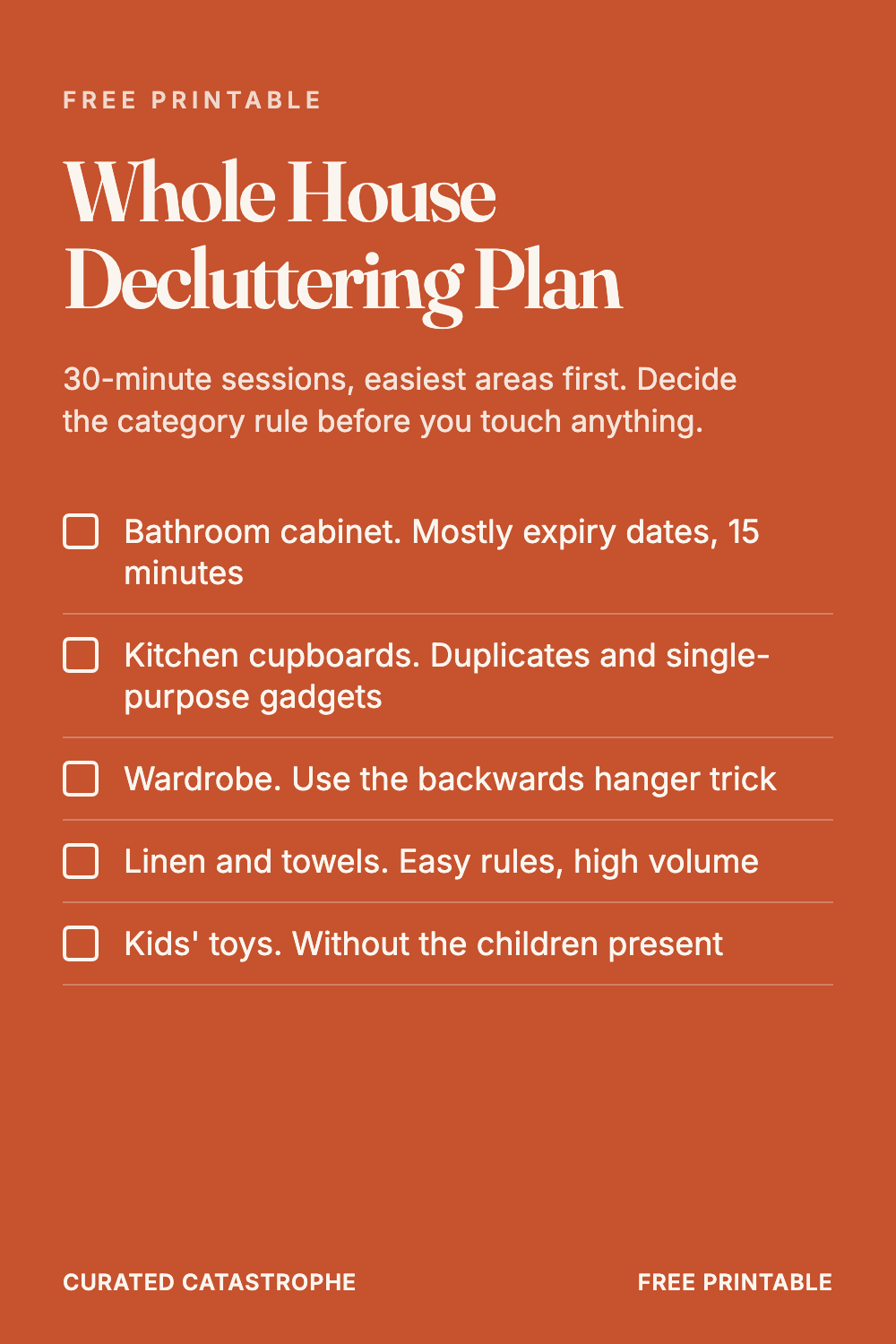
- Bathroom cabinet. Almost entirely expiry dates. Nearly no emotional weight. Fifteen minutes.
- Kitchen cupboards. Duplicates and single-purpose gadgets. Mildly annoying, not sad.
- Wardrobe. The first properly hard one. Use the hanger trick below.
- Linen and towels. Easy rules, high volume, very satisfying.
- Kids' toys. Do this without the children present, and do it in stages.
- Paperwork. Dull, slow, and best done in front of the television.
- Sentimental items. Last. Always last, and never in the first month.
The wardrobe, specifically
Wardrobes need their own method because "do I wear this?" is a question everyone answers optimistically.
The hanger trick: turn every hanger backwards. When you wear something, hang it back the normal way. In six months, anything still backwards has objectively not been worn. It removes the guessing entirely.
For everything else, three honest questions:
- Would I buy this again today, at full price?
- Does it fit now, not at some hypothetical future point?
- If it needs repair, have I had it in the pile for more than three months?
What to do with the stuff
The single biggest cause of relapse is bags of donations sitting in the hallway for a month until somebody quietly puts them back.
- Book the collection before you start. Give yourself a deadline that involves another person.
- Put donations in the car boot immediately, not by the front door.
- Sell almost nothing. Selling is a second project with its own admin. Unless an item is worth a genuinely meaningful amount, donating it is worth the time you get back.
What helps
Deliberately short list, because buying things to fix having too many things has an obvious flaw.
- Bin bags and boxes you already own. Do not buy storage at this stage. Buying storage before you finish is the classic error, because you will size it for the volume you have now rather than the volume you end up with.
- A label maker, but only after you have finished a room and know what actually lives there.
- Vacuum storage bags for genuinely seasonal bedding and coats, once the volume is settled.
- Clear drop-front boxes for anything you need to see, which is most things. Opaque storage is where possessions go to be forgotten and re-bought.
The maintenance bit
Decluttering once achieves nothing on its own. Two habits keep it from creeping back:
- One in, one out, applied only to categories that have caused you trouble before. Applying it to everything is unsustainable.
- A ten-minute reset, once a week, on the one surface that always collects things. Everyone has one. It is usually a kitchen worktop or a dining table.
That is genuinely it. The maintenance is much smaller than the initial job, which is the part nobody tells you when you are on hour four of the wardrobe.
What actually helps
- A label maker
Only after a room is finished and you know what actually lives there.
- Vacuum storage bags
For genuinely seasonal bedding and coats, once the volume is settled.
- Clear drop-front boxes
Opaque storage is where possessions go to be forgotten and re-bought.
Common questions
Where should you start when decluttering a whole house?
The bathroom cabinet. It is almost entirely expiry dates with no emotional weight, so it builds momentum before you reach anything difficult. Sentimental items come last, and never in the first month.
Why do people put everything back when they declutter?
Because they make hundreds of individual decisions and run out of steam. Deciding at category level first, such as one set of bed linen per bed plus a spare, removes most of those decisions before you touch anything.
How long should a decluttering session be?
About 30 minutes on one small area. Emptying a whole room before deciding anything guarantees you run out of energy at the exact moment the mess is at its worst.
Whole House Decluttering Plan
30-minute sessions, easiest areas first. Decide the category rule before you touch anything.
Download the free PDFSave this for later
Rather not decide?
Should I keep this? answers it for one object in four questions.
Keep reading
- Decluttering
The Garage Declutter, in Four Sessions
The hardest room in the house because nothing in it has a decision attached. Four sessions, in an order that stops you giving up.
- Decluttering
The Pre-Christmas Declutter, Done in November
Not a deep clean. Four hours in November that stop December being the month everything arrives into a house with no room for it.
- Decluttering
How to Stop Clutter Coming Back After You Declutter
Decluttering once achieves nothing on its own. The four habits that stop everything creeping back, and why most maintenance advice is unsustainable.