Decluttering
How to Stop Clutter Coming Back After You Declutter
Why does clutter always come back after decluttering?
Because clutter is an arithmetic problem, not a storage one. If more comes into the house than leaves it, no amount of organising fixes it, and buying storage just raises the ceiling on how much accumulates before you notice.
Most people can declutter. Almost nobody can keep a house decluttered, which is why so many people have done it three or four times and concluded they are the problem.
They are not. Decluttering is an event. Staying decluttered is a system, and most of the systems people are told to use are far too demanding to survive a normal month.
The real cause: inflow, not storage
Clutter is not a storage failure. It is an arithmetic one. If more comes in than goes out, no amount of organising fixes it, and buying storage just raises the ceiling on how much can accumulate before you notice.
So the habits below are almost all about inflow.
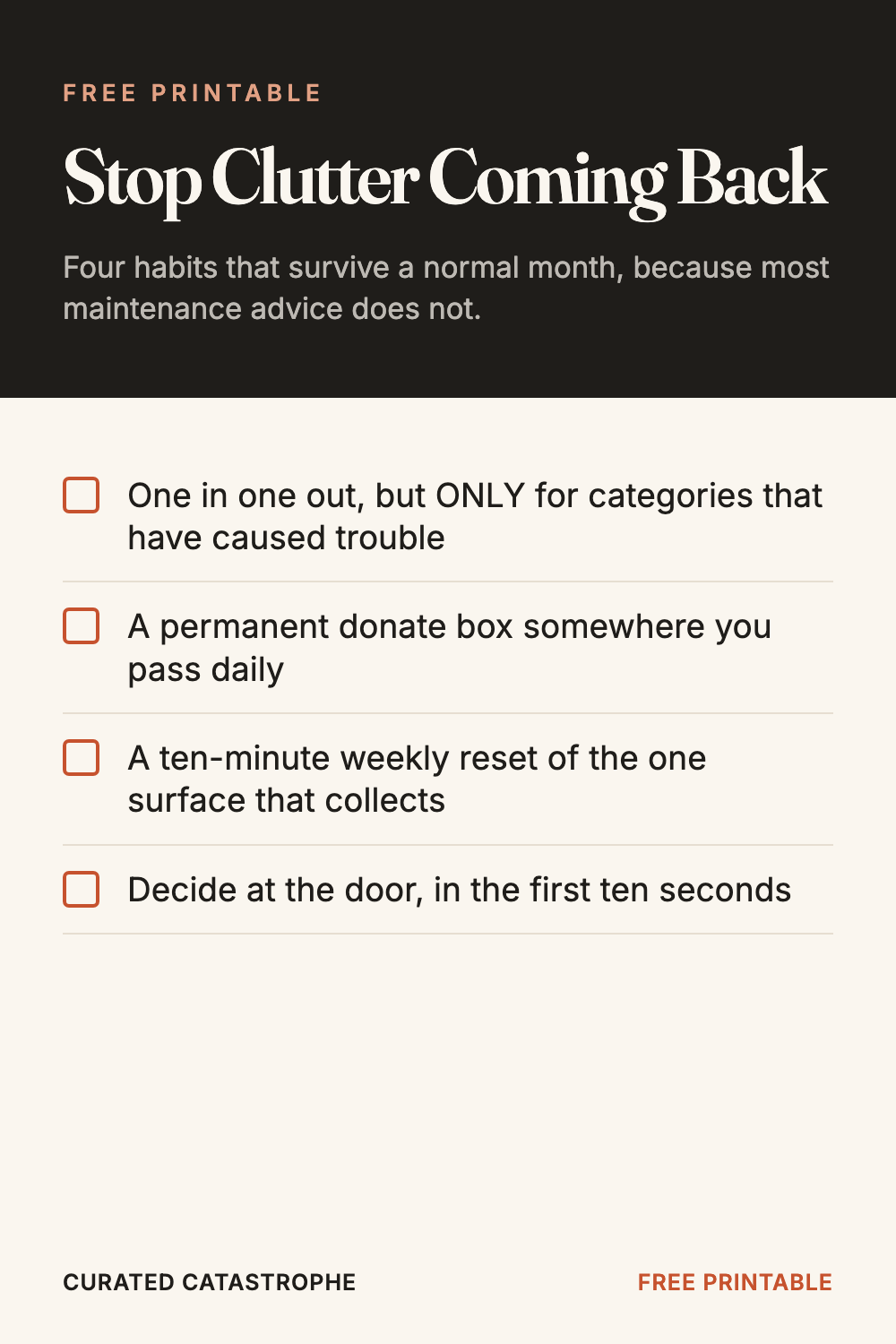
Habit one: one in, one out, but only where it hurts
The standard advice is to apply one in one out to everything. Nobody sustains that.
Apply it only to the two or three categories that have actually caused you trouble. For most households that is clothes, kids' toys, and kitchen gadgets. Everything else can look after itself.
Narrow rules get followed. Universal rules get abandoned in week three.
Habit two: a permanent donate box
Not a decluttering session. A box, somewhere accessible, permanently.
- Something stops fitting, breaks its usefulness, or irritates you: it goes in the box
- When the box is full, it goes in the car
- When it is in the car, it goes on the next trip past a charity shop
The point is that removal becomes continuous and decision-free rather than an annual ordeal you have to psych yourself up for.
Habit three: the ten-minute surface reset
Every house has one surface that collects things. A kitchen worktop, a dining table, a chair, the bottom of the stairs.
You do not need to reset the house. You need to reset that one surface, once a week, for ten minutes. It is the early warning system for everything else.
When that surface stays clear, the house rarely gets bad. When it stays covered for a fortnight, everything else is already sliding.
Habit four: decide at the door
Most clutter is decided in the first ten seconds it enters the house, and then never revisited.
- Post: bin the junk before you put it down, not later
- Packaging: goes straight to the recycling, not "to the garage"
- Gifts and freebies: if you would not have bought it, it goes in the donate box now, while it is still giftable, not in two years when it is not
- Bags of things from other people: opened and sorted the same day, or they become furniture
Why "just be tidier" fails
Tidiness is a personality trait. Systems are not. Every habit above is designed to work on a Tuesday when you are tired and slightly fed up, because that is the actual test.
If a maintenance system only works when you feel motivated, it is not a system. It is a mood.
The realistic expectation
You will still need a proper declutter occasionally. Roughly once a year, and it will be small, because the habits above stop the accumulation reaching the point where it needs a weekend.
That is the actual goal: not a house that never needs sorting, but one where sorting it is a 90-minute job instead of a three-day one.
What helps
- A donate box or bag that lives somewhere you pass daily. Out of sight means out of use.
- A shredder near where post lands, because paper decisions deferred are paper decisions never made.
- A single tray for anything undecided, emptied weekly. Not a general in-tray, a deliberately small one that forces the decision when it fills.
- Nothing else. Buying storage at this stage is how the cycle starts again.
What actually helps
- A donate box or bag
Lives somewhere you pass daily. Out of sight means out of use.
- A shredder near where post lands
Paper decisions deferred are paper decisions never made.
- One deliberately small tray
For anything undecided, emptied weekly. Small on purpose, so it forces the decision when it fills.
Common questions
Why does clutter always come back after decluttering?
Because clutter is an arithmetic problem, not a storage one. If more comes into the house than leaves it, no amount of organising fixes it, and buying storage just raises the ceiling on how much accumulates before you notice.
Does one in one out actually work?
Only if you apply it narrowly. Applied to everything it gets abandoned within weeks. Applied to the two or three categories that have genuinely caused you trouble, usually clothes, toys and kitchen gadgets, it sticks.
What is the simplest habit for staying decluttered?
A permanent donate box somewhere you pass daily. It makes removal continuous and decision-free rather than an annual ordeal you have to psych yourself up for.
Stop Clutter Coming Back
Four habits that survive a normal month, because most maintenance advice does not.
Download the free PDFSave this for later
Rather not decide?
Should I keep this? answers it for one object in four questions.
Keep reading
- Decluttering
How to Declutter Your Whole House Without Losing a Weekend
A room-by-room decluttering plan in 30-minute sessions, with a decision rule that stops you putting everything back.
- Decluttering
The Pre-Christmas Declutter, Done in November
Not a deep clean. Four hours in November that stop December being the month everything arrives into a house with no room for it.
- Decluttering
The Garage Declutter, in Four Sessions
The hardest room in the house because nothing in it has a decision attached. Four sessions, in an order that stops you giving up.