Decluttering
The Garage Declutter, in Four Sessions
How do I declutter a garage?
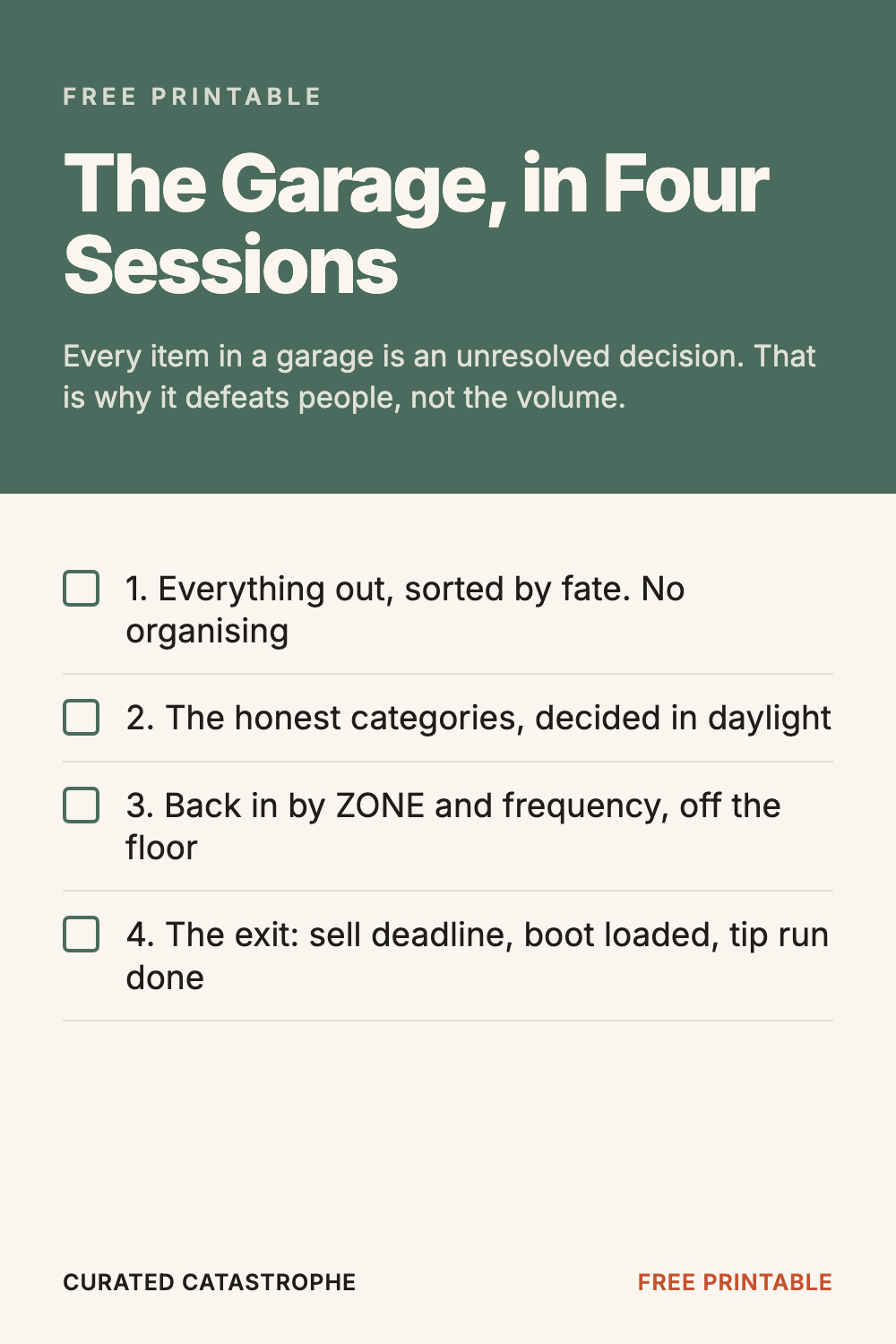
In four sessions. Everything out and sorted by fate with no organising, then the decisions made in daylight, then things back in by zone and frequency with the floor kept clear, then the exit: deadlines on the sell pile and the tip run actually done. Book the skip or tip slot before you start.
The garage is where objects go when a decision has been deferred. Nothing lives there because it belongs there; it lives there because nobody knew where else to put it.
That is why garages defeat people. It is not the volume. It is that every single item is an unresolved decision, so a garage clear-out is hundreds of decisions in a row, in the cold, with nowhere to put anything down.
Four sessions, in this order, fixes most of that.
Before you start
Two practical things that make the difference between finishing and abandoning it.
- Book the disposal first. A skip, a tip run, a collection, booked for a specific date. Working towards a deadline you have already paid for changes the whole dynamic
- Do it in dry weather, because session one requires emptying onto the drive
And one safety point that matters more in a garage than anywhere: if you find old paint tins, chemicals, gas canisters, or anything you cannot identify, those go to a household waste site, not in a skip and not down a drain. Most councils take them free.
Session one: get it out and sort by fate
Three or four hours. This is the hardest one and it is mostly physical rather than mental.
Everything out onto the drive, then into five zones. Do not organise, do not put anything back.
- Rubbish, straight into the skip as you go
- Belongs in the house, and it goes into the house today
- Sell or donate
- Genuinely lives in the garage
- No idea — one pile, dealt with in session two
The rule that keeps this moving: do not open boxes you have not opened in five years, just look at the top layer. If the top layer is nothing, the box is nothing.
Session two: the honest categories
Now the decisions, and they are much easier in the open with everything visible.
Almost always goes
- Paint more than a few years old, which has separated and cannot be used
- Broken things kept for parts you have never once harvested
- Boxes for appliances past their warranty
- Offcuts of wood and carpet "in case", which never gets used
- Anything rusted through, perished, or seized
- Exercise equipment nobody has touched in two years
Usually stays
- Tools you have used in the last two years
- Seasonal things with an actual season: garden furniture, decorations
- Car things: screenwash, jump leads, a spare bulb
- One tin each of the paints currently on your walls, labelled with the room
Session three: zones, and get it off the floor
Only now do things go back, and they go back by frequency of use, not by type.
- Waist height, by the door: the things used weekly. Bins, recycling, the shoes, the dog lead
- Shelves, reachable: tools, car things, the current-season items
- High or deep: the genuinely seasonal. Decorations, camping gear, the parasol
- Wall-mounted: anything long-handled. Spades, rakes, ladders, bikes
- Floor: as close to nothing as you can manage
Getting things off the floor is the single change that makes a garage stay usable, because a floor with things on it becomes a floor with more things on it.
Session four: the exit
The part people skip, and skipping it is why the garage refills.
The sell pile has a deadline. The donate pile goes in the car boot, not by the garage door. The tip run happens on the booked date. Anything unsold by the deadline gets donated rather than relisted, which is the same discipline that empties the pile of things too good to bin.
A garage cleared but with four piles still in it has not been cleared.
Keeping it
The garage refills because it is the path of least resistance for undecided objects. The fix is a rule rather than a system.
Nothing enters the garage that does not have a home in it. If it has no zone, it does not go in, which forces the decision at the door rather than deferring it for another five years. One annual pass, ideally when you get the seasonal things out anyway, keeps it honest.
What helps
- Wall-mounted racks and hooks, which is how the floor stays clear.
- Clear lidded boxes, because you will not remember what is in an opaque one.
- A shelving unit rated for real weight, not a flat-pack one that bows.
- A dedicated tin for car things, so they are not spread across four shelves.
- A booked skip or tip slot, which is the deadline the whole plan runs on.
What actually helps
- Wall-mounted racks and hooks
How the floor stays clear, which is what keeps a garage usable.
- Clear lidded boxes
You will not remember what is in an opaque one.
- Heavy-duty shelving
Rated for real weight, not a flat-pack unit that bows.
Common questions
How do I declutter a garage?
In four sessions. Everything out and sorted by fate with no organising, then the decisions made in daylight, then things back in by zone and frequency with the floor kept clear, then the exit: deadlines on the sell pile and the tip run actually done. Book the skip or tip slot before you start.
What should I throw away from the garage?
Paint more than a few years old, broken things kept for parts you have never harvested, boxes for appliances past warranty, offcuts kept 'in case', anything rusted or perished, and exercise equipment untouched for two years.
How do I dispose of old paint and chemicals?
At a household waste recycling centre, which takes them free in most areas. Never in a skip and never down a drain. If you find containers you cannot identify, take advice rather than guessing.
The Garage, in Four Sessions
Every item in a garage is an unresolved decision. That is why it defeats people, not the volume.
Download the free PDFSave this for later
Rather not decide?
Should I keep this? answers it for one object in four questions.
Keep reading
- Decluttering
How to Declutter Your Whole House Without Losing a Weekend
A room-by-room decluttering plan in 30-minute sessions, with a decision rule that stops you putting everything back.
- Decluttering
The Pre-Christmas Declutter, Done in November
Not a deep clean. Four hours in November that stop December being the month everything arrives into a house with no room for it.
- Decluttering
How to Stop Clutter Coming Back After You Declutter
Decluttering once achieves nothing on its own. The four habits that stop everything creeping back, and why most maintenance advice is unsustainable.