Decluttering
How to Declutter When You Cannot Decide What to Keep
Why can I not decide what to declutter?
Because you are being asked to make an open-ended decision with no criteria, no limit and no way to be wrong safely. Set a container so the space is fixed, use a dated test instead of asking whether you want it, and make the decision reversible with a sealed box and a date.
Some people can look at an object and know. Most cannot, and the standard advice is written by and for the people who can.
If you pick something up, turn it over, put it down again, and have done that four times with the same object across two years, the problem is not willpower. It is that you are being asked to make an open-ended decision with no criteria, no limit, and no way to be wrong safely.
All three of those are fixable.
Why the deciding is hard
Three things make an object genuinely difficult, and they are worth naming because each has a different fix.
- No criteria. "Do I want this" has no answer. "Have I used it in a year" does.
- No limit. With infinite space every answer is "keep", because keeping costs nothing at the moment of deciding.
- No safety. If a wrong decision is permanent, the safe move is always to keep, so you keep everything.
Set a container before you start
The single most effective change: decide the space first, then fit things into it.
One shelf for the mugs. One box per child. This drawer for cables. When the container is full, something has to leave for something to arrive, and suddenly you are not asking "is this worth keeping" in the abstract. You are asking "is this better than the one already in there", which is a comparison, and comparisons are enormously easier than absolute judgements.
Almost nobody can answer "do I need this?". Almost everybody can answer "which of these two do I like more?" Turn every decision into the second kind.
The four questions that produce answers
Use these instead of asking whether you want it.
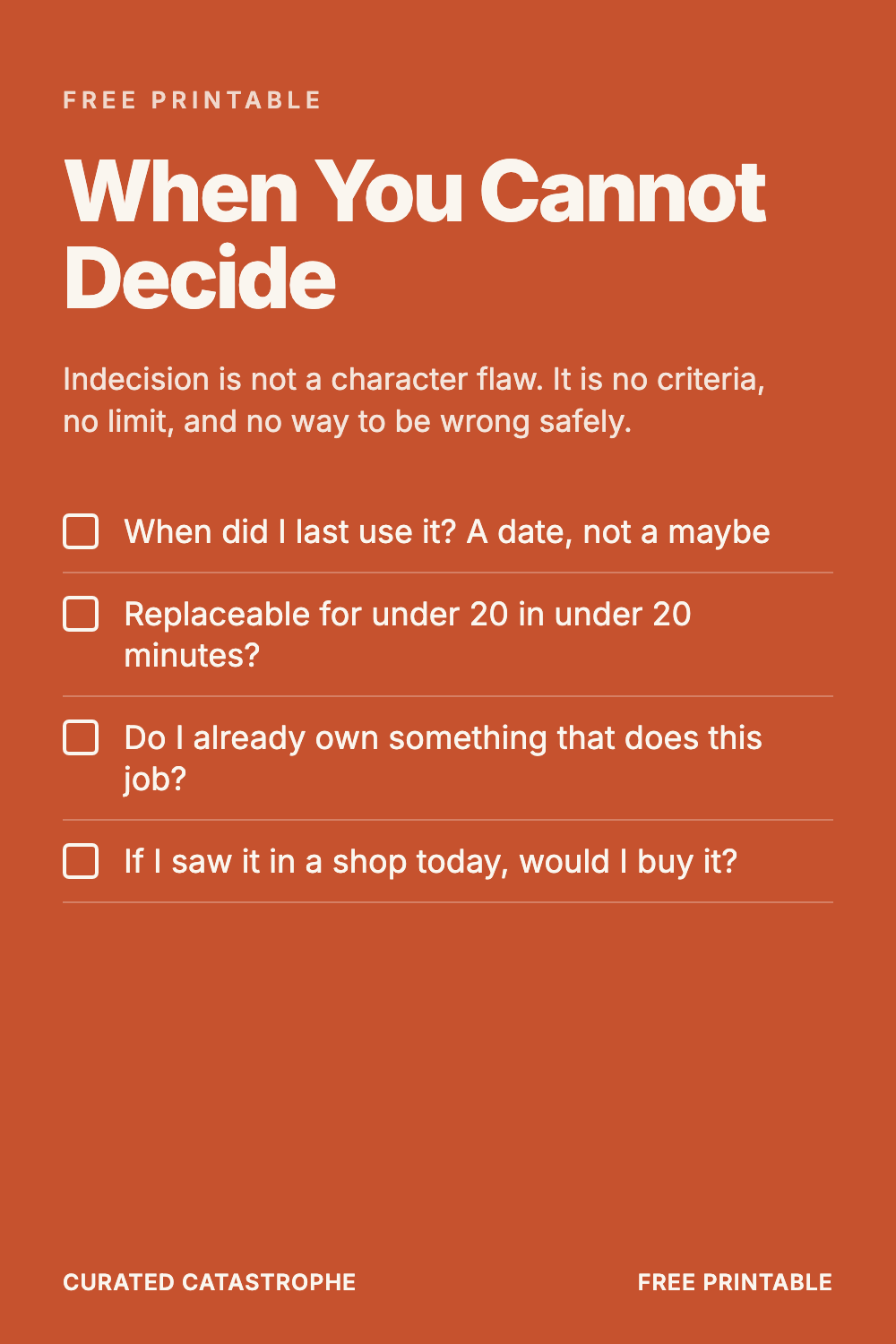
- When did I last use it? Not "would I", not "could I". A date.
- Could I replace it for under about twenty pounds in under twenty minutes? If yes, and you have not used it in a year, it goes.
- Do I have another one that does this job? Duplicates are the easiest wins and there are always more than you think.
- If I saw it in a shop today, would I buy it? Cuts through everything you have merely got used to owning.
There is an interactive version of exactly this in should I keep this?, which asks four questions about one object and commits to an answer.
Make being wrong safe
This is the fix for indecision specifically, and it removes most of the paralysis.
The box with a date. Anything you genuinely cannot decide goes in a box, sealed, labelled with today's date and a date six months out. Put the box somewhere accessible, not in a loft.
If you need something, open it and take it out. That is allowed and it is the point. If the date arrives and the box has not been opened, it goes without being opened.
The decision is now reversible for six months, which is what makes it possible to make at all. Give yourself one or two boxes. Ten means you are using them to avoid the whole thing.
Reduce the number of decisions
Decision fatigue is real and it is cumulative. Fewer, easier decisions beat more, harder ones.
- Sort by category, not by room. All the mugs at once, all the cables at once. You decide once about mugs rather than fifteen times.
- Do the easy categories first. Cables, expired food, duplicates, obvious rubbish. Momentum is real and easy wins build it.
- Sentimental last, always. Doing it first is why people stall on the first box and never get to the easy volume.
- Twenty minutes, then stop. Quality of decision drops sharply after that, and decisions made tired are the ones later regretted.
The two rules that prevent regret
Never bin something belonging to someone else. Not a partner, not an adult child, not a housemate. That is a different problem with a different method.
Do not decide sentimental things in a bad year. Bereavement, divorce, illness. Box those with a date and come back. That is a decision, not avoidance.
If nothing works
If you have tried repeatedly, the volume is affecting how you can use your home, and the thought of letting things go causes real distress rather than mild reluctance, that is not untidiness and this page is not the right tool.
Hoarding disorder is recognised and treatable, and approaching it as a tidying problem tends to make it worse. Speaking to a GP is a reasonable next step and a more useful one than another method.
What helps
- A few lidded boxes in one size, which are the containers that make limits physical.
- A roll of masking tape and a marker, for the date on the box.
- A timer, so twenty minutes means twenty minutes.
- One donation bag kept permanently by the door, so decisions leave the house.
What actually helps
- Lidded boxes in one size
Containers are what make a limit physical rather than theoretical.
- Masking tape and a marker
For the date on the box, which is what makes the decision reversible.
- A timer
So twenty minutes actually means twenty minutes.
Common questions
Why can I not decide what to declutter?
Because you are being asked to make an open-ended decision with no criteria, no limit and no way to be wrong safely. Set a container so the space is fixed, use a dated test instead of asking whether you want it, and make the decision reversible with a sealed box and a date.
What is the box and date method?
Anything you genuinely cannot decide goes into a box, sealed and labelled with today's date and a date six months out, kept somewhere accessible rather than the loft. If you need something you open it, which is allowed and is the point. If the date arrives unopened, it goes unopened.
How do I avoid decision fatigue when decluttering?
Sort by category rather than by room so you decide once about mugs rather than fifteen times, do the easy categories first for momentum, leave sentimental things until last, and stop after twenty minutes because decision quality drops sharply after that.
When You Cannot Decide
Indecision is not a character flaw. It is no criteria, no limit, and no way to be wrong safely.
Download the free PDFSave this for later
Rather not decide?
Should I keep this? answers it for one object in four questions.
Keep reading
- Decluttering
The Garage Declutter, in Four Sessions
The hardest room in the house because nothing in it has a decision attached. Four sessions, in an order that stops you giving up.
- Decluttering
How to Declutter Your Whole House Without Losing a Weekend
A room-by-room decluttering plan in 30-minute sessions, with a decision rule that stops you putting everything back.
- Decluttering
Decluttering Someone Else's Things Without a Row
You cannot declutter another adult. What you can do is negotiate space, and there is a real difference.