Cleaning schedules
Cleaning With a Newborn: The Absolute Minimum That Still Works
How do I keep the house clean with a newborn?
Do three things daily: deal with anything that will smell or grow, move one load of washing one stage, and keep one clear surface where you eat. Then four weekly jobs whenever they happen. Everything else genuinely does not matter on a three-month timescale.
There is a particular kind of advice aimed at new parents that suggests you can keep a beautiful home if you just use the nap times well.
You cannot, and you should not try. The first months with a newborn are a period where the house is meant to slip, and the useful question is not how to keep it nice. It is which few things genuinely have to happen so that nothing goes actually wrong.
That list is much shorter than people expect.
The daily three
These are non-negotiable, and together they take about fifteen minutes, done whenever they happen to be possible.
- Anything that will smell or grow. Nappy bin out, food waste out, dishes not left overnight with milk in them.
- One load of washing moved one stage along. Not a full laundry day. One load, one stage.
- A clear surface where you eat. One place to put a plate down that is not covered.
That is the whole daily routine. If a day only contains those three things, the day was a success.
The weekly four
Whenever in the week they happen, in any order, by whoever is available.
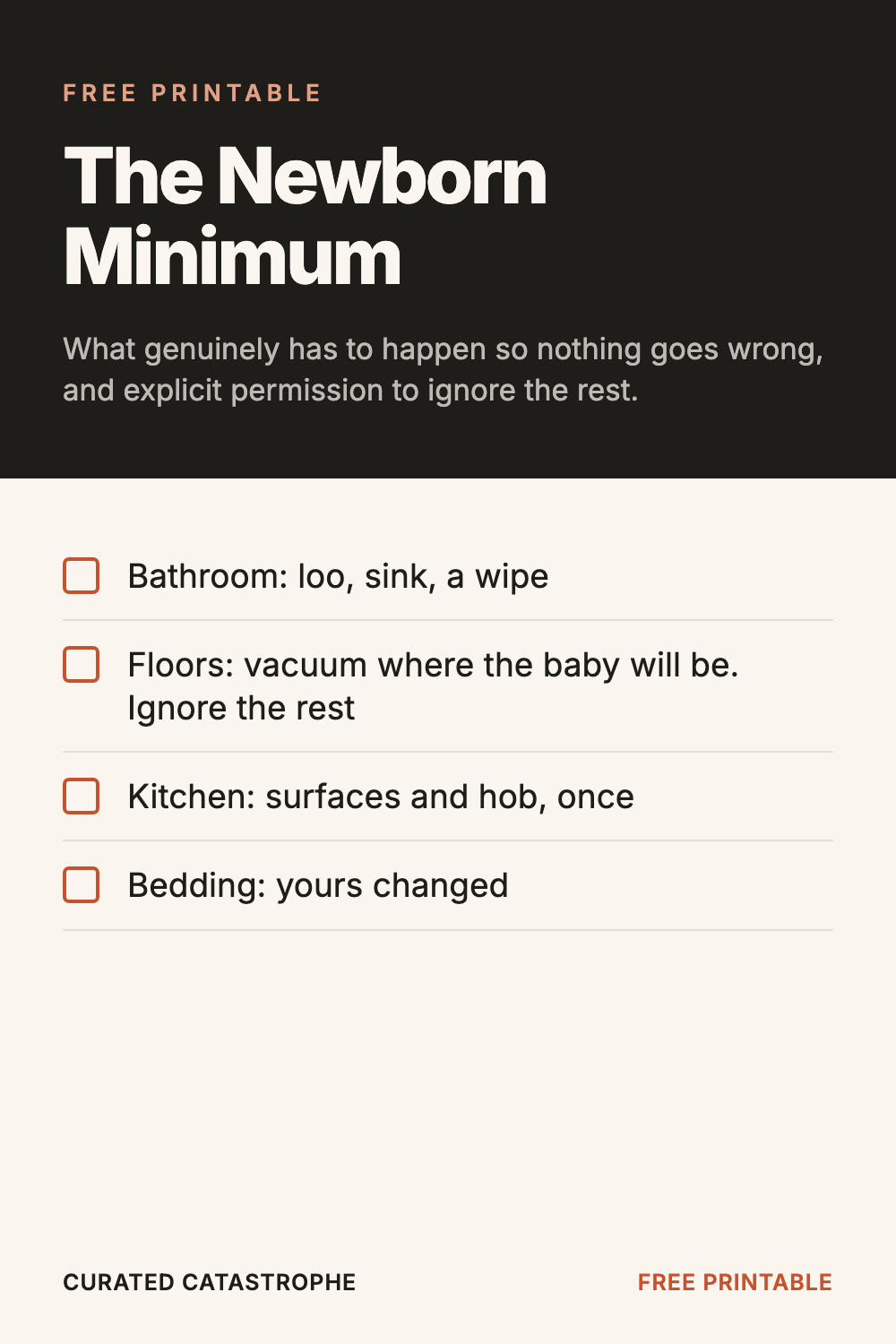
- Bathroom: loo, sink, a wipe of the surfaces
- Floors: vacuum where the baby will be, ignore the rest
- Kitchen: surfaces and the hob properly, once
- Bedding: yours, changed. Theirs, as often as needed
Four jobs a week. If two of them happen, that is still fine.
The ignore list, explicitly
This is the part most advice will not say plainly. For the first three months or so, genuinely do not do these:
- Dusting, anywhere
- Windows, skirting boards, light fittings
- The oven, the fridge interior, descaling anything
- Ironing, of anything, at all
- Any room with a door you can close
- Deep cleaning of any kind
- Reorganising anything, however much you want to nest
None of these matter on a three-month timescale. Every one of them is time that would come out of sleep.
A house with a new baby in it is supposed to look like a house with a new baby in it. Anyone who visits and judges the state of your skirting boards has told you something useful about them.
Set the house up once, early
If you are still pregnant, this is worth more than any amount of cleaning later. Reduce the number of steps for the things you will do fifty times a day.
- A nappy station on every floor, so you are never carrying a baby up stairs for a wipe
- Bins in the rooms where they are needed, with liners nearby
- A basket in each room for the general drift, emptied when convenient
- Muslins and spare clothes in several places, not in one perfectly organised drawer
- Food in the freezer, which is the single highest-return preparation there is
Accepting help, specifically
People will offer. Most will say "let me know if you need anything", which is impossible to act on.
Have three specific answers ready: bring a meal, put a load of washing through, or take the baby for an hour while I sleep. Naming the task makes it far more likely to happen and far easier for them.
If anyone offers to clean and you can bear it, the bathroom is the job to give away.
When it starts to matter again
Somewhere around three or four months, most households find capacity returning, and that is the moment to restart a real routine rather than trying to catch up on the whole house at once.
Start with the ten-minute daily reset and add one weekly job at a time. If the house has genuinely got away in the meantime, the sequenced recovery is the right approach: rubbish first, one room finished at a time, and no deep cleaning until everything is merely clean.
What helps
- A nappy bin with a proper seal, which is the smell problem solved.
- Multiple laundry baskets, so sorting happens where clothes come off.
- A cordless vacuum, because the barrier is fetching the vacuum, not using it.
- Paper plates for a fortnight, if it comes to that. It is a reasonable trade.
- A freezer of cooked meals, prepared before the birth if at all possible.
What actually helps
- A sealed nappy bin
The smell problem, solved in one purchase.
- Several laundry baskets
So sorting happens where the clothes come off.
- A cordless vacuum
The barrier is fetching the vacuum, not using it.
Common questions
How do I keep the house clean with a newborn?
Do three things daily: deal with anything that will smell or grow, move one load of washing one stage, and keep one clear surface where you eat. Then four weekly jobs whenever they happen. Everything else genuinely does not matter on a three-month timescale.
What cleaning can I skip with a new baby?
Dusting, windows, skirting boards, light fittings, the oven, the fridge interior, all ironing, any room with a door you can close, and any deep cleaning or reorganising. None of it matters over three months, and every one of those jobs comes out of sleep.
How do I ask for help with a new baby?
Have three specific answers ready, because 'let me know if you need anything' is impossible to act on. Bring a meal, put a load of washing through, or take the baby for an hour while I sleep. If someone offers to clean, give away the bathroom.
The Newborn Minimum
What genuinely has to happen so nothing goes wrong, and explicit permission to ignore the rest.
Download the free PDFSave this for later
Rather not decide?
Build your cleaning schedule and get a routine sized to your actual household.
Keep reading
- Cleaning schedules
The Autumn Cleaning Checklist: The Jobs to Do Before Winter
The jobs that are far easier now than in December, and the handful that genuinely cost money if you skip them.
- Cleaning schedules
Cleaning Routines for Homes With Pets
Hair, muddy paws and the smell you stopped noticing. What to do daily, what to do weekly, and what genuinely does not help.
- Cleaning schedules
The Monthly Cleaning Schedule Nobody Tells You About
The jobs that need doing every four to six weeks, the ones that quietly make a house feel neglected when they slip. One page, twelve months.