Cleaning schedules
A Cleaning Schedule for Shift Workers and Irregular Hours
How do I keep a house clean working shifts?
Anchor the routine to your position in the shift cycle rather than to days of the week. A work day gets the ten-minute minimum only, the first day off after nights gets nothing because it is a sleep day, and the deeper jobs are split into four blocks done one per cycle.
Every cleaning schedule ever published assumes the same week: office hours, evenings free, weekends off. If you work nights, rotating shifts, or on-call, none of it applies and the failure is constant.
The problem is not effort. It is that a day-based routine cannot survive a week where Tuesday is sometimes a workday, sometimes a sleep day, and sometimes both.
So do not anchor to days. Anchor to shifts.
Anchor to the cycle, not the calendar
A shift pattern has a shape even when the dates move: work days, the day off after nights, the proper rest days.
Assign jobs to positions in that cycle rather than to named days.
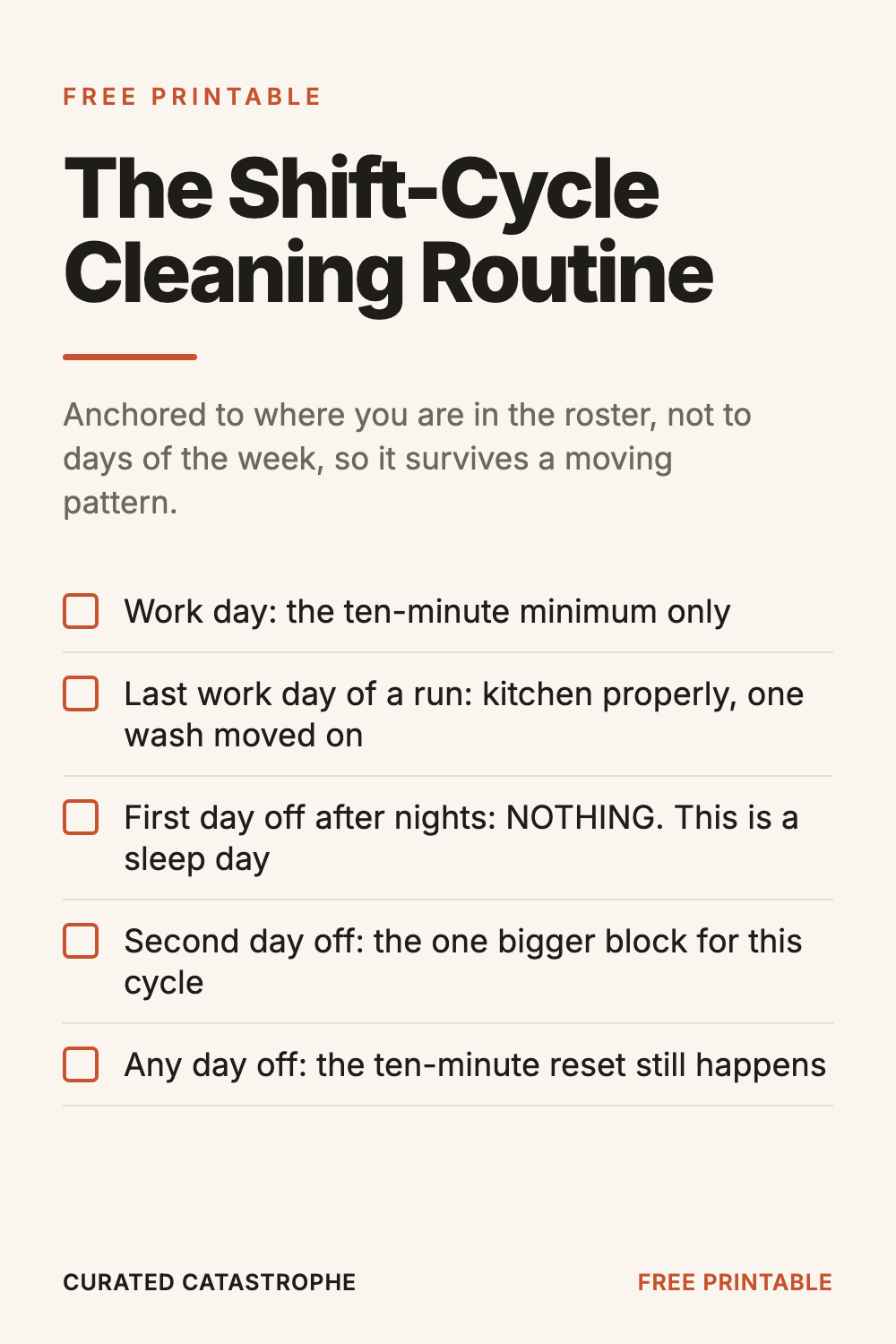
- Work day: the ten-minute minimum only. Nothing else
- Last work day of a run: kitchen properly, one load of washing moved through
- First day off after nights: nothing. This is a sleep day and it is not a cleaning day
- Second day off: the one bigger job for that cycle, rotating
- Any day off: the ten-minute reset still happens
The cycle repeats whether it lands on a Wednesday or a Sunday, which is the entire point.
The ten-minute minimum
On a work day this is the whole routine, and it should be the same three things every time so it needs no decisions from a tired brain.
- Kitchen surfaces and the sink
- One load of washing moved one stage along
- Anything that will smell by tomorrow
That is it. It keeps a house from sliding without asking anything of you on a day you have nothing to give, and it is a compressed version of the fifteen-minute daily reset.
Protect the sleep day, absolutely
The single most common mistake shift workers make is trying to reclaim the first day off by doing everything on it.
That day is for sleep. Sleep debt after nights is a physiological problem, not a motivation one, and a house cleaned at the cost of it will be undone within the week because you will be too wrecked to maintain anything.
A routine that eats into recovery is not a routine, it is a loan. You pay it back with interest in the second half of the roster.
The block system for rotating rosters
If your pattern rotates, split the deeper jobs into four blocks and do one per cycle rather than one per week.
- Bathrooms properly
- Floors throughout
- Kitchen beyond the daily: fronts, hob, one appliance
- Bedrooms and change the bed
Four blocks, one per cycle, means everything gets covered roughly monthly regardless of how the dates fall. Write which block is next on the fridge, because the whole point is not having to remember where you are.
Sharing a house with day workers
Worth being explicit about, because this causes more friction than the cleaning itself.
- Agree which jobs are yours by cycle rather than by day
- Agree what happens in your sleep window: no vacuum, no washing machine, no hoovering above your room
- Write it down. "You do the bathroom, I do the floors" survives; "we will just sort it out" does not
Night shift specifics
- Do the kitchen before you sleep, not after. Coming home to a clean kitchen after a night shift matters more than for anyone else
- Blackout and a fan or white noise are cleaning-adjacent: they protect the sleep that makes everything else possible
- Bins out on a phone alarm, not on memory. Collection day is the single job most often missed on nights
- Batch cooking matters more here than anywhere. A freezer meal after a night shift is the difference between eating properly and not, which is what cooking double is for
When a cycle gets skipped
It will. A bad run, a swapped shift, illness.
Skip the block, do not double up next cycle. Doubling is how people end up abandoning the whole system after one bad fortnight. The block will come round again, and a house that had one four-week gap in the floors is completely fine.
What helps
- A whiteboard on the fridge with only the next block written on it.
- A machine with a delay timer, so washing finishes when you are awake rather than at 3am.
- Phone alarms for the bins, which is the job that memory reliably loses.
- Blackout blinds and white noise, which protect the sleep the whole system depends on.
What actually helps
- A fridge whiteboard
With only the next block written on it, so you never have to remember where you are.
- A machine with a delay timer
So a load finishes when you are awake rather than at 3am.
- Blackout blinds
Protects the sleep the whole system depends on.
Common questions
How do I keep a house clean working shifts?
Anchor the routine to your position in the shift cycle rather than to days of the week. A work day gets the ten-minute minimum only, the first day off after nights gets nothing because it is a sleep day, and the deeper jobs are split into four blocks done one per cycle.
Should I clean on my day off after night shifts?
No. The first day off after nights is for sleep. Sleep debt after nights is physiological rather than a motivation problem, and a house cleaned at the cost of recovery gets undone within the week because you will be too wrecked to maintain anything.
What is the minimum cleaning to keep a house from sliding?
Three things: kitchen surfaces and the sink, one load of washing moved one stage along, and anything that will smell by tomorrow. Ten minutes, the same three every time so it needs no decisions from a tired brain.
The Shift-Cycle Cleaning Routine
Anchored to where you are in the roster, not to days of the week, so it survives a moving pattern.
Download the free PDFSave this for later
Rather not decide?
Build your cleaning schedule and get a routine sized to your actual household.
Keep reading
- Cleaning schedules
The Realistic Weekly Cleaning Schedule (For People With Jobs)
A weekly cleaning routine built around about 20 minutes a day, designed to be kept rather than admired. Free printable included.
- Cleaning schedules
The 15-Minute Daily Reset That Stops a House Sliding
The short evening routine that keeps a house from ever getting properly bad, built around three jobs and a timer rather than willpower.
- Cleaning schedules
The Deep Cleaning Checklist, Room by Room (Printable)
A room-by-room deep cleaning checklist split into 45-minute sessions, so you can do it over a fortnight instead of losing an entire weekend.