Decluttering
The Linen Cupboard: How Much Bedding You Actually Need
How many sets of bedding do I actually need?
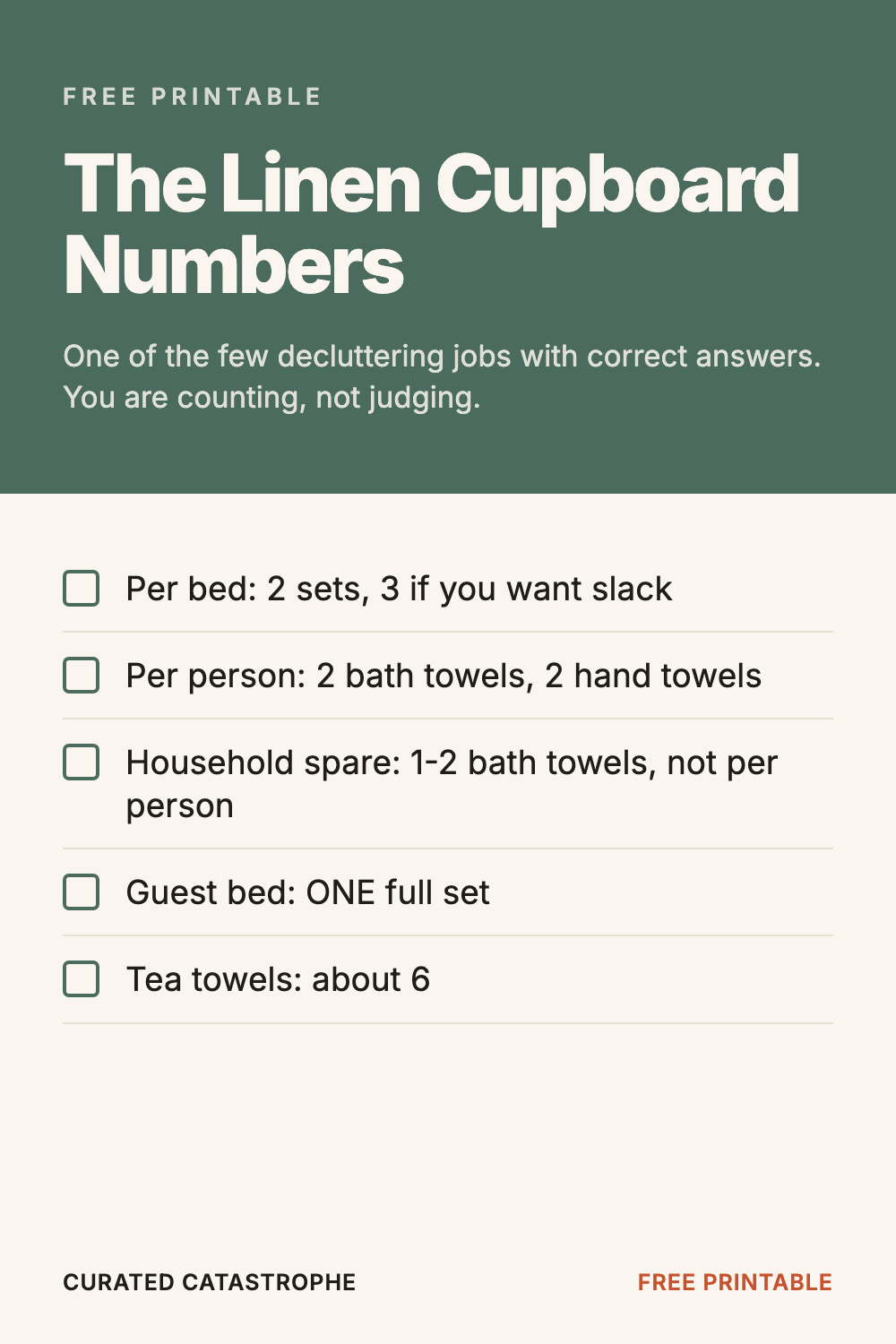
Two per bed, or three if you want slack: one on the bed, one in the cupboard, optionally one in the wash. For towels, two bath and two hand towels per person, plus one or two household spares. Guest beds need one full set, not four.
Linen cupboards accumulate quietly. Nothing wears out fast enough to notice, nothing gets thrown away, and every set of sheets that has ever entered the house is probably still in there.
This is one of the few decluttering jobs with genuinely correct numbers, which makes it one of the easiest. You are not making judgement calls, you are counting.
The numbers
Per bed: two sets, three if you want slack.
One on the bed, one in the cupboard, and optionally one in the wash. Two is workable, three is comfortable, and anything beyond three is storage rather than use.
Towels, per person: two bath towels and two hand towels. Plus one or two spare bath towels for the household, not per person.
Guest bedding: one full set per guest bed. Not four sets for a bed used twice a year.
Tea towels: about six. They are the exception, because they get through the wash fastest.
That is the entire calculation. A four-person household with three beds needs roughly six to nine sheet sets, ten to twelve bath towels and six tea towels, and most households have two or three times that.
Sort into four, not two
The four-way sort is what makes this fast, because "keep or bin" stalls on the middle ground.
- In use. Good condition, fits a bed you own, you would put a guest in it.
- Demoted. Worn, faded, stained but intact. These become the dog bed, the picnic blanket, the dust sheet for painting, the car boot layer.
- Rags. Cut up for cleaning cloths. A worn cotton sheet is better than any bought cloth and this uses up most of the middle pile.
- Out. Beyond even that.
Most people find the "in use" pile is already big enough on its own, which makes the rest easy.
The things to actually get rid of
- Sheets that fit a bed you no longer own. The single most common thing in a linen cupboard, and it is a clean decision
- Anything with elastic gone. A fitted sheet that will not stay on is not a fitted sheet
- Thin, bobbled or grey-white towels, which do not dry and take up full-sized space
- Duvets and pillows past their life. Pillows last roughly two years, duvets five or so. Fold a pillow in half; if it stays folded, it is done
- Single sets from incomplete sets, unless the pieces genuinely still get used
Storing it so it stays sorted
Store each set inside its own pillowcase. Sheet, duvet cover and the second pillowcase all folded into one, so a set comes out as a unit and you never hunt for the matching piece. It is the single best storage trick there is for bedding.
Then:
- Stack by bed size, in separate columns, labelled on the shelf edge rather than on the linen
- Guest bedding at the top, since it is used least
- Towels folded to the shelf depth so nothing hangs over the front
- Leave a gap. A packed cupboard is one you stop putting things back into properly
Where the extras go
Old towels and bedding are one of the few things with a genuinely eager destination: animal shelters and vets take them almost universally, in any condition, including stained.
Textile recycling takes the rest. Charity shops mostly will not take duvets and pillows, so checking first saves them the disposal cost, which is covered in things too good to bin.
The airing cupboard problem
If yours contains the boiler, it is warm, and warm is not neutral storage.
Do not keep anything in there long term that you mind yellowing. Warmth ages cotton and sets stains you cannot see yet. Guest bedding stored for a year in an airing cupboard often comes out distinctly less white than it went in, which is why the least-used sets should be the ones nearest the door rather than nearest the tank.
What helps
- Shelf dividers, so stacks stay in their columns instead of merging.
- Labels on the shelf edge, which survive the linen being taken in and out.
- Vacuum bags for genuine spares only, not for everyday sets you need access to.
- A pillow test done annually, folded in half, which settles the argument in two seconds.
What actually helps
- Shelf dividers
So stacks stay in their columns instead of merging.
- Shelf-edge labels
They survive the linen being taken in and out.
- Vacuum bags for genuine spares
For spares only, never for the sets you need access to.
Common questions
How many sets of bedding do I actually need?
Two per bed, or three if you want slack: one on the bed, one in the cupboard, optionally one in the wash. For towels, two bath and two hand towels per person, plus one or two household spares. Guest beds need one full set, not four.
How do I store bedding sets so they stay together?
Fold the sheet, duvet cover and second pillowcase into one of the pillowcases, so the whole set comes out as a single unit and you never hunt for a matching piece. Then stack by bed size in separate columns with the labels on the shelf edge.
When should you throw away pillows and duvets?
Pillows last roughly two years and duvets about five. Fold a pillow in half; if it stays folded rather than springing back, it is done. Charity shops mostly will not take either, but animal shelters will, and textile recycling takes the rest.
The Linen Cupboard Numbers
One of the few decluttering jobs with correct answers. You are counting, not judging.
Download the free PDFSave this for later
Rather not decide?
Should I keep this? answers it for one object in four questions.
Keep reading
- Decluttering
Laundry Room Organisation When It Is Actually a Cupboard
No laundry room, just a machine in a cupboard or under a worktop. Storage that works in the space around it.
- Decluttering
Bathroom Organization When There Is No Cabinet
Storage for small bathrooms with no built-in cupboards, plus the expiry dates on toiletries nobody checks.
- Decluttering
Christmas Decoration Storage That Makes Next December Easy
Everything that goes wrong in December was decided in January, in a hurry, by someone who wanted it over with.