Decluttering
What to Do With Things That Are Too Good to Bin
What can I do with things too good to throw away?
Decide the destination once, per category. Wearable clothes and working electricals to a charity shop; anything stained or holed to textile recycling, which takes it in any condition; towels and old bedding to an animal shelter; craft supplies to a school; tools to a repair cafe; the awkward middle to a buy-nothing group.
There is a pile somewhere in most houses. By the front door, in the boot of the car, on a chair in the spare room. It is the things that are definitely going, just not yet.
They are too good to bin and nobody has decided where they go. So they sit, which is the worst of both outcomes: you have already given up the space, and you have not got the benefit of the decision.
Why the pile exists
Not laziness. It is that "get rid of it" is not one decision, it is two: deciding to let it go, which you have already done, and deciding where it goes, which you have not.
The second decision is harder because it is genuinely complicated. Charity shops will not take everything, recycling rules differ by council, and selling takes effort. Faced with that, the pile waits.
The fix is to decide the destination in advance, per category, once.
Where things actually go
Charity shops will take
- Clean clothes in wearable condition, shoes in pairs
- Books, though they are flooded with them, so specialist and children's books are more useful
- Working small electricals, complete crockery, unopened toiletries
- Complete toys and games with all the pieces
Charity shops will NOT take, and it costs them money to dispose of
- Anything stained, holed or broken
- Duvets and pillows, in most cases
- Car seats, cots and prams, for safety and liability reasons
- Electrical items that do not work
- Half-used toiletries and opened cosmetics
Donating something a charity shop has to pay to throw away is not a donation. It is passing the disposal cost to a charity, which is worse than binning it yourself.
Textile recycling takes clothes, bedding and towels in any condition, including stained and holed. This is the destination for the entire "not good enough to donate" pile, and most people do not know it exists.
Electrical recycling takes anything with a plug or a battery. Any shop selling electricals must take back an equivalent item, and councils collect small electricals.
Specific homes that want specific things
- Towels and old bedding: animal shelters, almost always
- Craft supplies: schools, nurseries, care homes, scout groups
- Tools: repair cafes, men's sheds, community workshops
- Spectacles: many opticians collect them
- Furniture in good condition: local reuse charities, who often collect for free
Selling: only for three things
Be honest about the rate. Selling is worth it for high value, easy postage, or genuine collectability. For everything else you are working for about two pounds an hour.
Set a price, set a deadline, and when the deadline passes it gets donated. Most stalled piles are full of things somebody intends to sell.
The one-week rule
The rule that actually empties the pile: anything in it has a destination and a date, or it goes to the fastest available option.
- Bag it by destination, not by room, and label the bags
- Put a specific date in the calendar, attached to a trip you were making anyway
- Bags go in the car boot immediately, not by the door
- Anything without a destination after one week goes to the charity shop or textile recycling, whichever will take it
The car boot detail matters more than it sounds. A bag by the front door gets stepped over. A bag in the boot leaves next time you drive anywhere.
Buy-nothing groups
The best option for the awkward middle: things too good to bin, not worth selling, and not quite right for a charity shop. Half a tin of paint, a spare curtain pole, a bag of jam jars.
Somebody chooses it deliberately, collects it, and it goes today. The main risk is arranging collection with several people, so state "first to reply, porch collection" and stick to it.
Preventing the next pile
The pile is a symptom. It builds because things enter the house faster than a destination gets decided, which is the same underlying pattern behind clutter coming back.
One permanent donation bag, somewhere obvious, emptied on a schedule rather than when full, stops it reforming. This is the difference between an occasional purge and a system.
What helps
- A permanent donation bag or box in one fixed place, not a pile that moves around.
- Sturdy reusable bags, because charity shops are not equipped for split carriers.
- A note in your phone of what your local council actually collects, checked once.
- A recurring calendar entry attached to a trip you already make.
What actually helps
- A permanent donation box
One fixed place, emptied on a schedule rather than when full.
- Sturdy reusable bags
Charity shops are not equipped for split carriers.
Common questions
What can I do with things too good to throw away?
Decide the destination once, per category. Wearable clothes and working electricals to a charity shop; anything stained or holed to textile recycling, which takes it in any condition; towels and old bedding to an animal shelter; craft supplies to a school; tools to a repair cafe; the awkward middle to a buy-nothing group.
What will charity shops not accept?
Anything stained, holed or broken, duvets and pillows in most cases, car seats, cots and prams, electricals that do not work, and half-used toiletries. Donating something they have to pay to dispose of passes the cost to the charity, which is worse than binning it yourself.
Why does my donation pile never leave the house?
Because getting rid of something is two decisions, not one: deciding to let it go, which you have done, and deciding where it goes, which you have not. Bag it by destination and put the bags in the car boot rather than by the front door.
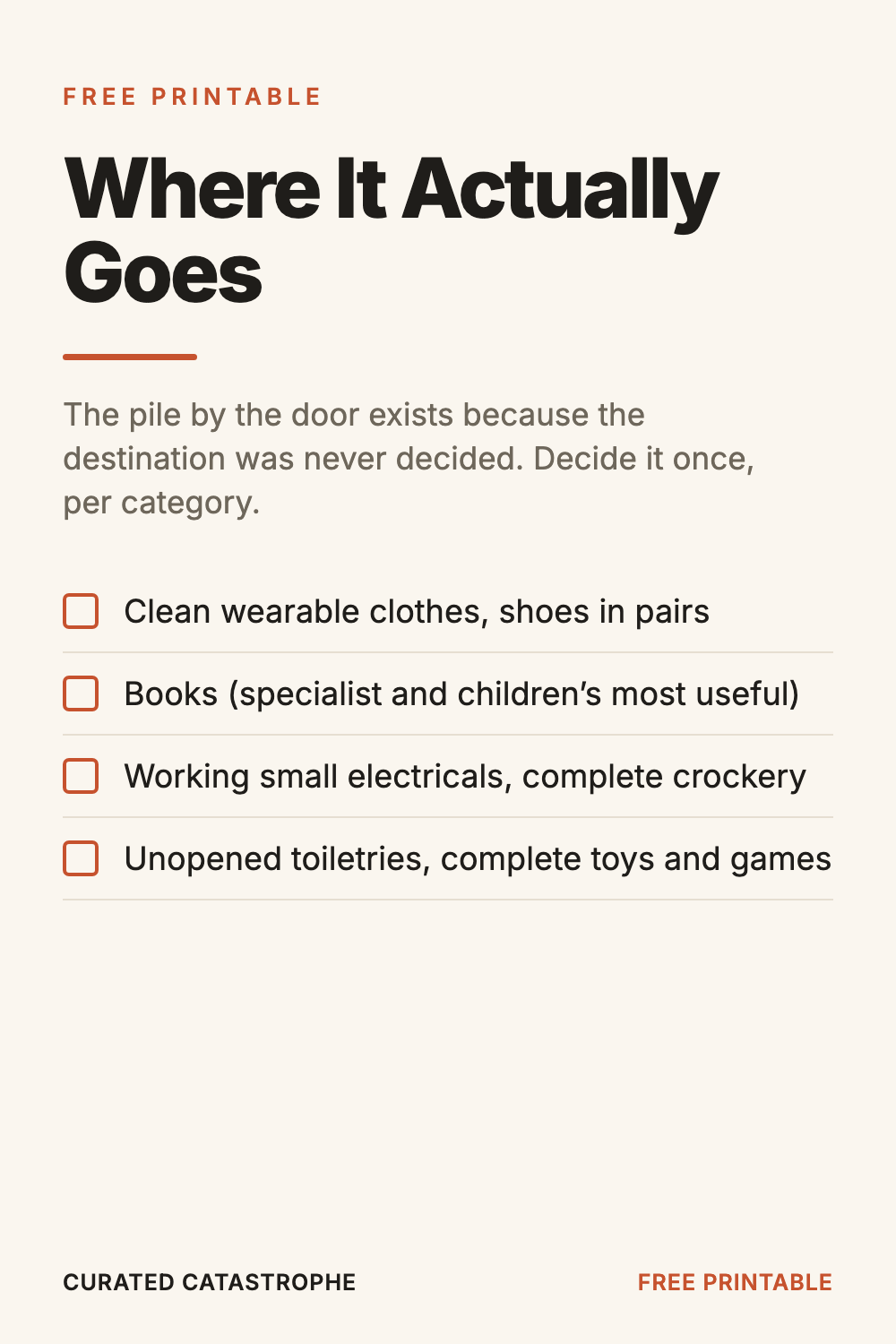
Where It Actually Goes
The pile by the door exists because the destination was never decided. Decide it once, per category.
Download the free PDFSave this for later
Rather not decide?
Should I keep this? answers it for one object in four questions.
Keep reading
- Decluttering
Seasonal Storage: What to Keep and Where
Four times a year, the same swap. A system that means things come out undamaged and you can find them.
- Decluttering
Christmas Decoration Storage That Makes Next December Easy
Everything that goes wrong in December was decided in January, in a hurry, by someone who wanted it over with.
- Decluttering
Craft and Hobby Supplies: An Honest Cull
Written for people who genuinely make things. The problem is not the supplies, it is the projects you have already abandoned.