Decluttering
Decluttering Books When You Love Books
How do I declutter books when I love reading?
Stop asking whether you love each one, because you love books. Ask what job it is doing: will read, will reread, reference, beautiful object, or identity book. The first four earn their shelf. The fifth is where the space actually is.
Almost every piece of writing about decluttering books is aimed at people who own about nine of them, and it always contains the same instruction: keep only the ones that spark joy.
For somebody who actually reads, that produces one of two outcomes. Either everything stays, because books are the thing you love, or you get talked into a cull you quietly regret for years.
There is a better question, and it is not about joy.
The question that works
Not "do I love this". You love books; that is the premise.
Ask instead: is this book doing a job for me? Books do about five different jobs, and it is worth knowing which one each is doing, because two of those jobs can be done by something other than the physical object.
The five categories
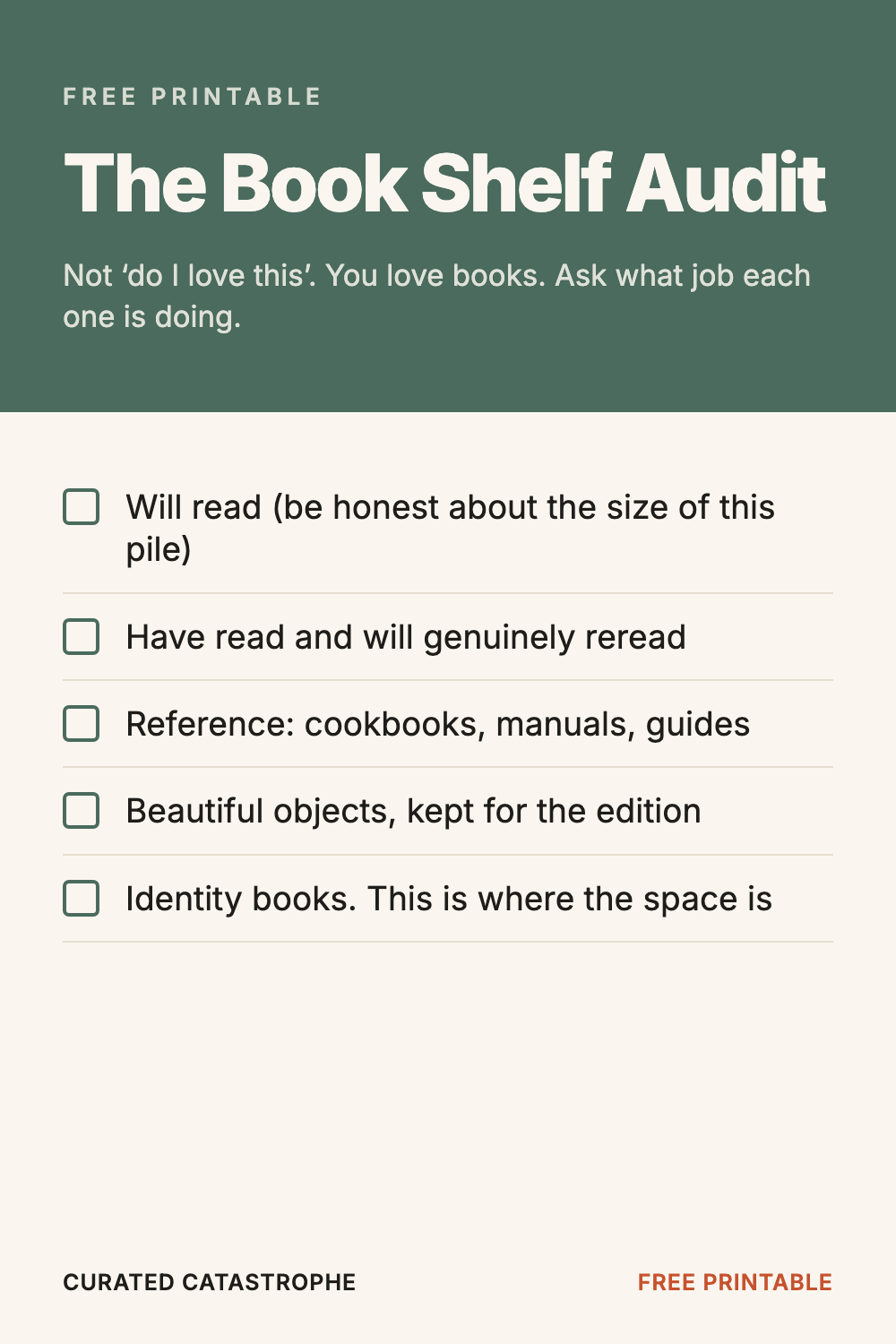
- Will read. Genuinely, and reasonably soon. Be honest about the size of this pile: an unrealistic one is where the guilt comes from.
- Have read and will reread. The real rereads, which for most people is a much shorter list than the shelf suggests.
- Reference. Cookbooks, manuals, field guides, anything you dip into. Keep these near where they are used, not with the novels.
- Beautiful objects. Bought for the edition or the illustrations. A completely legitimate reason to own a book, and one that most methods refuse to acknowledge.
- Identity books. The ones kept because owning them says something about you. This is the category where the space actually goes, and naming it honestly is most of the work.
Categories one to four earn their shelf. Category five is where you find the room.
The unread pile, honestly
There is a Japanese word, tsundoku, for buying books faster than you read them, and having a stack of unread books is genuinely fine. It is a reading list with covers.
But be realistic about rate. If you read twenty books a year and own two hundred unread ones, that is a decade of reading, and some of those were bought by a person with different interests to the one you are now. Keeping the ones you would buy today is a fair test, and it is much kinder than asking whether you should have bought them.
A book you feel guilty about is not doing you any good on the shelf. It is doing you harm every time you look at it, which is the opposite of what a library is for.
Do it by shelf, not by house
One shelf at a time, taken right off, dusted, then refilled deliberately. It takes about twenty minutes and produces a visible result, which is what keeps it going.
Doing the whole collection at once is how people end up sitting on the floor surrounded by piles at midnight, having made no decisions at all.
The rules that make it easier
- A physical limit. These shelves are the library. When they are full, something leaves for something to arrive. It is far easier to enforce a shelf than a number.
- No double stacking. Books behind books are books you have effectively already lost.
- Textbooks go. Editions change and the information is online. This is the easiest category on the list and often the heaviest.
- The library exists. Anything you can borrow in a week does not need owning, and using the library also keeps the will-read pile honest.
Where they should actually go
Charity shops are flooded with books and often pulp what they cannot sell quickly.
Better destinations: a local Little Free Library, a school or nursery for children's books, a hospital or care home, a specialist secondhand dealer for anything genuinely collectable, or a buy-nothing group where somebody chooses them deliberately. Textbooks and the very common paperbacks are the ones charity shops least need.
It matters more than it sounds, because "somewhere they will be read" is what makes the decision feel acceptable rather than wasteful, which is exactly the problem covered in things too good to bin.
What helps
- Adjustable shelving, since fixed shelves waste enormous vertical space on paperbacks.
- Proper bookends, which is what lets a half-full shelf stay tidy rather than tipping.
- A library card, genuinely the highest-return item on this page.
- One shallow box for the outgoing pile, so it leaves the house rather than migrating.
What actually helps
- Adjustable shelving
Fixed shelves waste enormous vertical space on paperbacks.
- Proper bookends
What lets a half-full shelf stay tidy rather than tipping.
- A book box for the outgoing pile
One shallow box, so the pile leaves rather than migrating.
Common questions
How do I declutter books when I love reading?
Stop asking whether you love each one, because you love books. Ask what job it is doing: will read, will reread, reference, beautiful object, or identity book. The first four earn their shelf. The fifth is where the space actually is.
How many unread books is too many?
It depends on your reading rate rather than the number. Owning unread books is a reading list with covers, but if you read twenty a year and own two hundred unread, that is a decade of reading and some were bought by a person with different interests. Keep the ones you would buy today.
Where should I donate books?
Charity shops are flooded and often pulp what does not sell quickly. A Little Free Library, a school or nursery for children's books, a care home, a specialist dealer for anything collectable, or a buy-nothing group where somebody chooses them deliberately are all better destinations.
The Book Shelf Audit
Not ‘do I love this’. You love books. Ask what job each one is doing.
Download the free PDFSave this for later
Rather not decide?
Should I keep this? answers it for one object in four questions.
Keep reading
- Decluttering
How to Stop Clutter Coming Back After You Declutter
Decluttering once achieves nothing on its own. The four habits that stop everything creeping back, and why most maintenance advice is unsustainable.
- Decluttering
Craft and Hobby Supplies: An Honest Cull
Written for people who genuinely make things. The problem is not the supplies, it is the projects you have already abandoned.
- Decluttering
How to Declutter Your Whole House Without Losing a Weekend
A room-by-room decluttering plan in 30-minute sessions, with a decision rule that stops you putting everything back.