Decluttering
Craft and Hobby Supplies: An Honest Cull
How do I declutter craft supplies without regret?
Separate the supplies from the abandoned projects, because it is the abandoned projects taking the space and the containers. Supplies and a general stash are legitimate. For each stalled project choose one of four: finish it, undo it and return the materials, pass it on, or let it go.
Craft supplies are a special case, and most decluttering advice handles them badly by treating them as clutter with a hobby attached.
They are not. They are the raw material of something you actually do, and telling somebody to get rid of their yarn because they have a lot of it misses the point entirely.
The real problem is narrower and it is worth naming precisely: most craft storage is not supplies, it is abandoned projects and aspirational purchases, and those are what make the useful things impossible to find.
Sort into four
Take everything out. This is genuinely a whole-afternoon job and doing it partially does not work, because the whole issue is not being able to see what you own.
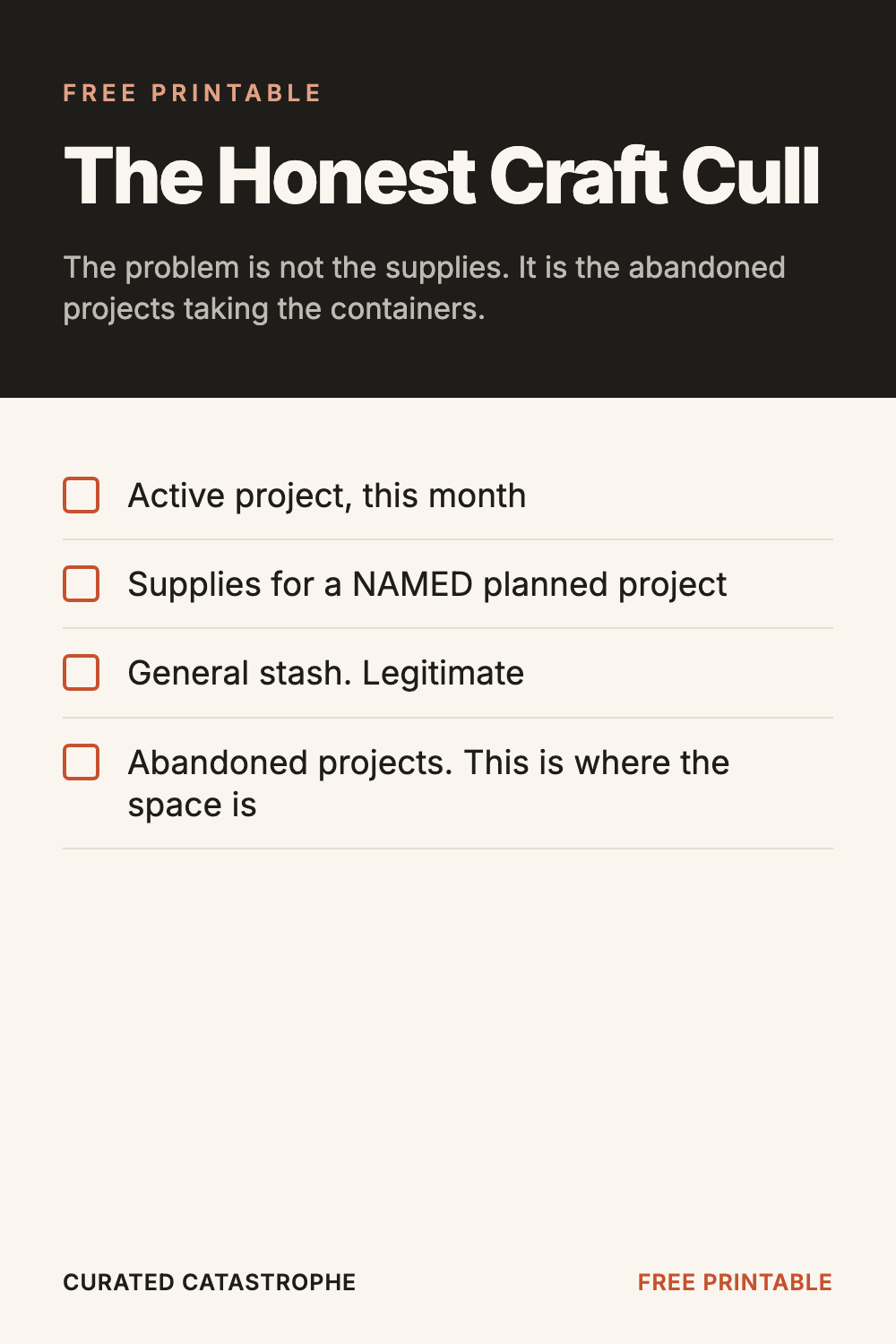
- Active project. Currently being worked on, this month.
- Supplies for a specific planned project, where you can name the project and roughly when.
- General supplies. The stash. Perfectly legitimate.
- Abandoned projects. Started, stalled, still taking up space and a container.
Piles one to three are fine. Pile four is where the space is.
The abandoned project decision
The hardest and most important category, because each one carries guilt and a container.
For each, pick one honestly:
- Finish it. Only if you can name the week you will do it. Otherwise this is not a real option
- Frog it. Undo it and return the materials to the stash. For knitting, crochet and most yarn work this is the obvious answer and people forget it is available
- Pass it on. Somebody in a craft group will happily finish a half-done quilt
- Let it go. The materials were not wasted. They bought you the hours you spent and the thing you learned
An abandoned project is not a debt. You did not fail it. It was an experiment that told you something, and the guilt attached to it is doing far more damage than the materials are worth.
Be honest about the aspirational stash
Every crafter has supplies for a craft they tried once. The lino cutting set, the resin kit, the loom.
The test is simple: have you touched it in two years, and would you buy it again today? If both are no, it goes, and it goes to somebody who will use it. Keeping it does not preserve the possibility; it just means the things you do use are harder to reach.
Store by project, not by material
This is the change that makes a craft space work, and it is counterintuitive.
Sorting by material looks tidier and is worse in practice, because starting a project then means gathering from six places. One box per active project, with everything in it, means you can pick it up and start.
- Active projects: one box each, everything in it, visible
- The stash: by material, in clear containers, since this is the browsing pile
- Tools: one place, together, not distributed between project boxes
- Small things: compartment boxes, and label them, because unlabelled compartments become a drawer
The limits worth setting
A container limit works far better than a number, and is much less painful than trying to decide piece by piece. This is the same container principle that works everywhere else.
- One drawer or box per craft. Full means something goes before something arrives
- One active project box per craft, so half-finished things cannot accumulate invisibly
- Scraps get a single container. When it is full, use them or let them go. Craft scraps expand to fill any space provided
Where supplies should go
Craft supplies have unusually eager destinations, which makes letting them go much easier than for most categories.
Schools and nurseries, scout and guide groups, care homes, community centres, art therapy programmes, and craft groups. A local buy-nothing group rehomes craft supplies faster than almost any other category, because somebody is always starting out.
Charity shops are the slowest option here, which is the opposite of most things and worth knowing.
What helps
- Clear stackable boxes, one per active project, so a project can be picked up whole.
- Compartment boxes with labels, for the small things that otherwise become a drawer.
- A single scrap container, deliberately limited.
- Vacuum bags for yarn and fabric, sealed, because moths are a real risk to a wool stash.
What actually helps
- Clear stackable project boxes
One per active project, so a project can be picked up whole.
- Labelled compartment boxes
For the small things that otherwise become a drawer.
- Vacuum bags for yarn and fabric
Moths are a real risk to a wool stash.
Common questions
How do I declutter craft supplies without regret?
Separate the supplies from the abandoned projects, because it is the abandoned projects taking the space and the containers. Supplies and a general stash are legitimate. For each stalled project choose one of four: finish it, undo it and return the materials, pass it on, or let it go.
What do I do with an unfinished project I will never finish?
Frogging it, which means undoing it and returning the materials to the stash, is the obvious answer for most yarn work and people forget it exists. Otherwise pass it to a craft group, where somebody will happily finish a half-done quilt.
Where can I donate craft supplies?
Schools, nurseries, scout and guide groups, care homes, community centres and art therapy programmes all want them, and a buy-nothing group rehomes craft supplies faster than almost any other category. Charity shops are the slowest option here, which is the opposite of most things.
The Honest Craft Cull
The problem is not the supplies. It is the abandoned projects taking the containers.
Download the free PDFSave this for later
Rather not decide?
Should I keep this? answers it for one object in four questions.
Keep reading
- Decluttering
Storage Ideas for a Rental You Cannot Alter
No drilling, no painting, nothing that leaves a mark. What actually holds weight and what pulls the paint off.
- Decluttering
Small Apartment Organization When You Cannot Drill Holes
Storage and organising ideas for rentals and small flats, all reversible, none requiring permission from a landlord.
- Decluttering
Decluttering Books When You Love Books
Most advice on this is written by people who do not read. A method that respects the collection and still gets the shelves back.