Decluttering
Seasonal Storage: What to Keep and Where
Where should I store seasonal items?
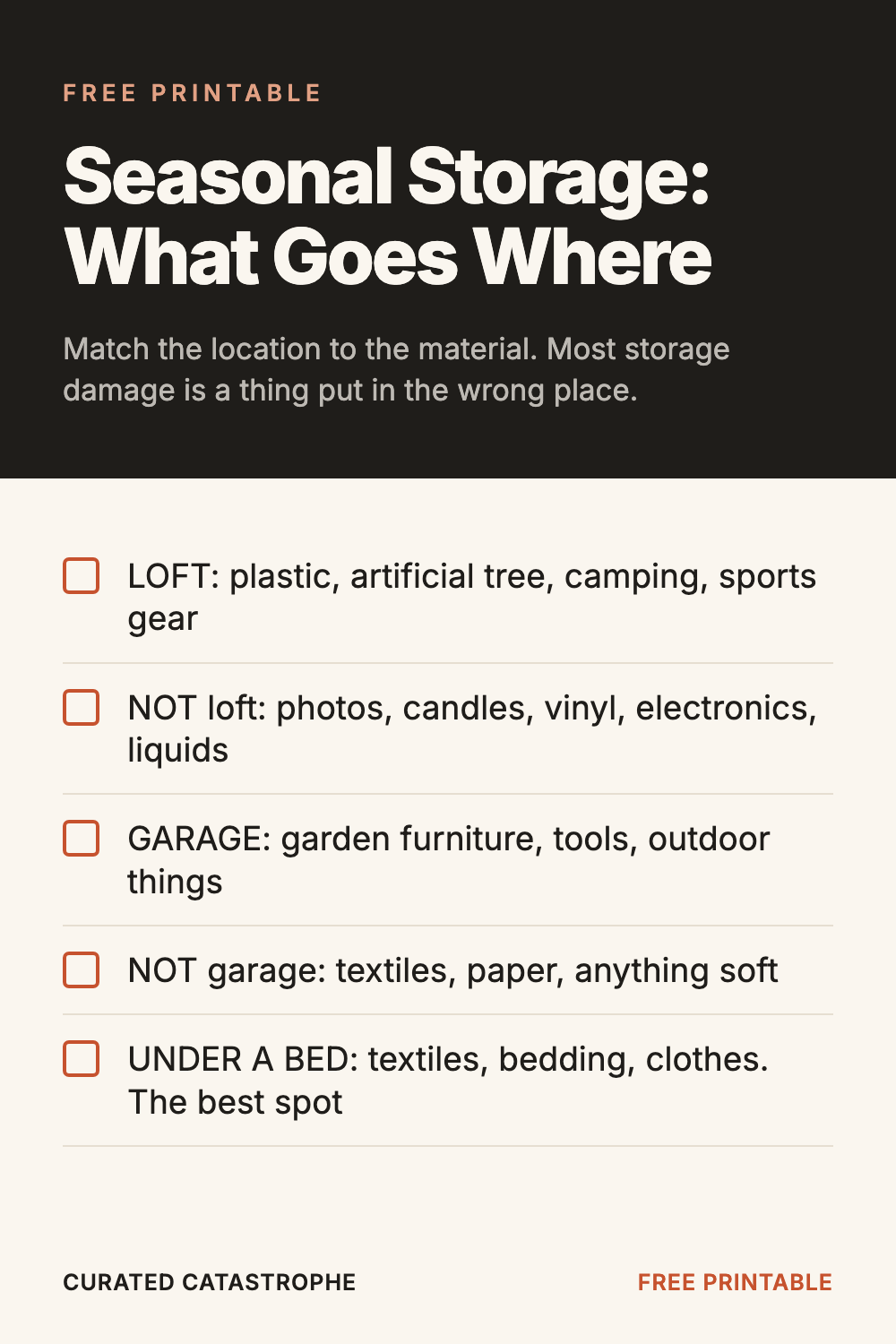
Match the location to the material. Lofts suit plastic, artificial trees and camping gear but never photographs, candles, electronics or liquids. Garages suit garden furniture and tools but never textiles or paper. Under a bed is the best place for anything soft.
Seasonal storage is a small job done badly by almost everyone, and the cost shows up months later: the parasol that went mouldy, the winter coat with moth holes, the box of decorations nobody can find.
The system is not complicated. It is mostly about where things go rather than how they are packed, and about writing down enough that next-you is not searching.
Match the location to the material
The most common mistake is treating all storage space as equivalent. It is not, and this table is most of the job.
Loft: hot in summer, freezing in winter, dry. Fine for plastic, artificial trees, camping gear and sports equipment. Never for photographs, candles, vinyl, electronics or anything liquid.
Garage or shed: damp, cold, prone to pests. Fine for garden furniture, tools and outdoor things. Never for textiles, paper or anything soft, which will come out smelling of it at best.
Under a bed: dry, stable, indoors. The best place for textiles, bedding and clothes. Use it for the things that matter and put the plastic in the loft.
Wardrobe top: dry and indoors. Good for the off-season clothes you rotate most often.
The general rule: anything soft, natural or sentimental stays inside the heated envelope of the house. Everything else can go out.
The four swaps
Attach each to something already happening rather than to a date, or it will not happen.
- Spring: winter clothes and bedding away, garden furniture out. Do it when you first open a window properly.
- Summer: nothing much. This is the one to skip.
- Autumn: summer clothes away, winter bedding out, garden things in. This is the big one and it belongs with the autumn jobs.
- Winter: decorations out, then away again in January, which is the swap most worth doing carefully.
Wash everything before it goes away
The rule that prevents almost all seasonal storage damage, and the one most often skipped.
Moths are attracted to sweat, food traces and body oils rather than to clean fabric, so an unwashed jumper is what gets eaten while a clean one beside it does not. Damp anything grows mould in a sealed box. Garden furniture put away dirty comes out stained permanently.
Wash it, dry it completely, then store it. A slightly damp item in a sealed bag is worse than no bag at all.
Containers, by what is going in
- Clear plastic with clip lids for most things. You will not remember what is in an opaque box
- Breathable cotton bags for natural fibres. Wool and silk need air; sealed plastic traps moisture against them
- Vacuum bags only for synthetics and bedding. They crush natural fibres and can set permanent creases in wool
- Cedar blocks or lavender rather than mothballs, which work nearly as well without the smell
- Never cardboard anywhere damp, and never for long-term textiles
Label so it is findable, not just labelled
A label saying "Christmas" on a box in a loft of twelve boxes is not much help.
Write what is inside and where it goes, on the side rather than the lid, in marker rather than on a sticker that falls off in the cold. Then keep a written list downstairs of what is stored and roughly where. That single sheet of paper saves more time than any container system.
Use the swap as a cull
The swap is the one moment you handle every item in a category, which makes it the best decluttering opportunity of the year and a free one.
- Anything not used at all last season goes now, rather than into storage
- Anything needing repair gets repaired this week or goes
- Anything you would not buy again today goes
Storing something for a year is not free. It costs space, and it costs the effort of moving it twice.
What helps
- Clear clip-lid boxes in one size, because mismatched boxes waste a third of a loft.
- Breathable cotton bags for wool and anything natural.
- Cedar blocks, which do the moth job without the charity-shop smell.
- A wide permanent marker, for labels readable across a dark loft.
- One written inventory kept downstairs, which is the highest-return item on this page.
What actually helps
- Clear clip-lid boxes, one size
Mismatched boxes waste a third of a loft.
- Breathable cotton storage bags
For wool and silk, which need air rather than a seal.
- Cedar blocks
The moth job without the charity-shop smell.
Common questions
Where should I store seasonal items?
Match the location to the material. Lofts suit plastic, artificial trees and camping gear but never photographs, candles, electronics or liquids. Garages suit garden furniture and tools but never textiles or paper. Under a bed is the best place for anything soft.
How do I stop moths getting into stored clothes?
Wash everything before storing it, because moths are attracted to sweat, skin oils and food traces rather than to the fabric itself, so an unwashed jumper is what gets eaten. Store wool in breathable cotton rather than sealed plastic, with cedar.
Should I use vacuum bags for storage?
Only for synthetics and bedding. They crush natural fibres, can set permanent creases in wool, and destroy the loft of down in a way that does not come back. Anything natural needs to breathe.
Seasonal Storage: What Goes Where
Match the location to the material. Most storage damage is a thing put in the wrong place.
Download the free PDFSave this for later
Rather not decide?
Should I keep this? answers it for one object in four questions.
Keep reading
- Decluttering
The New Year Home Reset: A Realistic January Plan
A four-week January reset that works with post-Christmas energy levels rather than against them. Week by week, with a printable plan.
- Decluttering
What to Do With Things That Are Too Good to Bin
The pile by the door that never leaves. Where each type of thing actually goes, and how to make it leave this week.
- Decluttering
How to Declutter When You Cannot Decide What to Keep
Chronic indecision is not a character flaw. It is decision fatigue, and there are structural fixes for it.