Cleaning schedules
The Spring Wardrobe Swap Checklist
How do I do a spring wardrobe swap?
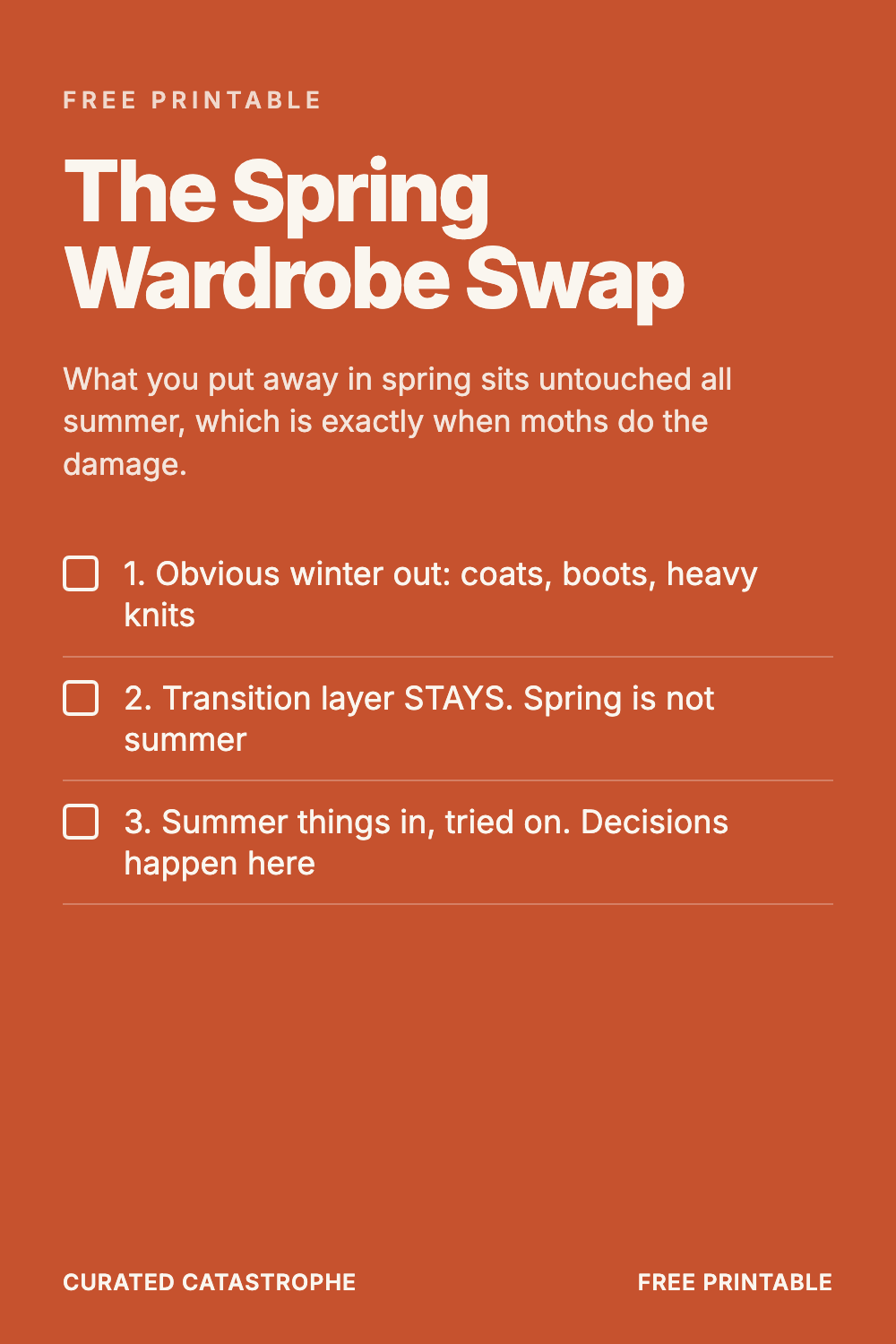
In three passes rather than one day: obvious winter out first with no decisions, then leave the transition layer in place because spring is not summer, then bring summer things in and try them on. By the third pass the wardrobe is half empty so it goes quickly.
The spring swap is the mirror of the autumn one, and it is the more consequential of the two, because what you put away in spring sits untouched through the warm months, which is exactly when moths do their damage.
It is also the best decluttering opportunity in the calendar. Not because spring is symbolically fresh, but because it is one of only two moments a year when every garment you own passes through your hands.
Do it in stages, not in a day
A wardrobe emptied onto a bed on a Saturday morning becomes a wardrobe still on the bed at midnight. Do it in three passes instead.
- Pass one: obvious winter out. Heavy coats, boots, thick knitwear. No decisions, just removal.
- Pass two: the transition layer stays. Cardigans, light jackets, jeans. Spring is not summer and putting these away in March is how you end up unpacking a box in April.
- Pass three: summer things in, tried on. This is where the decisions happen, and by now the wardrobe is half empty so it is quick.
Wash everything before storing it
The single most important thing on this page, and the most commonly skipped.
Moths are attracted to sweat, skin oils and food traces, not to wool itself. A worn jumper is what gets eaten; a clean one next to it usually does not. "I only wore it twice" is exactly the garment that comes out in October with holes in it.
Dry it completely. A slightly damp item in a sealed container grows mould, and that is unrecoverable in a way moth holes are not.
Storing by material
- Wool and cashmere: fold, never hang. Hanging stretches the shoulders permanently. Store breathable, with cedar
- Down coats: hang loosely or store uncompressed. Vacuum bags destroy loft and it does not come back
- Leather and sheepskin: breathable cover, never plastic. Plastic traps moisture and the leather goes mouldy
- Boots: stuffed with paper or boot shapers, upright, or they crease permanently at the ankle
- Synthetics and bedding: vacuum bags are fine, and this is the only category where they are
Where it goes
Under a bed, indoors, is the best place. Dry, stable temperature, and easy to reach in October.
Not the loft, unless the loft is genuinely dry and everything is sealed against moths. Not the garage or the shed, ever, for textiles. The seasonal storage locations guide covers why in more detail, but the short version is that anything soft or natural should stay inside the heated part of the house.
The one-year test, applied honestly
Every garment passing through your hands gets one question: did I wear this at all last winter?
- Not worn once: it goes now, not into the box. It will not be worn next year either
- Needs repair: repaired this week or it goes. It has been waiting since last April
- Does not fit: be honest about which direction and how long. One size, one season, is a reasonable hold. Three sizes and four years is a different thing
- Stained or bobbled beyond rescue: textile recycling, which takes it in any condition
That last point is worth knowing because it removes the guilt that keeps ruined clothes in a wardrobe. Nothing has to go in a bin, and charity shops do not want it. There is a fuller list of destinations in things too good to bin.
While the wardrobe is empty
Two minutes, and it only happens now.
Vacuum the base and the corners, which is where moth larvae actually live rather than on the clothes. Wipe the rail. Check for damp on the back wall, particularly if it is an external wall. Then put the cedar in before anything goes back.
Do the coats and boots properly
The things worn hardest and stored longest, and the ones most often put away dirty.
Coats to the dry cleaner or washed according to the label. Boots cleaned, dried away from direct heat, and polished or proofed before storage rather than in October when you want to wear them.
Wellies and winter boots stored upright and dry, never damp in a sealed box.
What helps
- Breathable cotton storage bags, for anything wool or natural.
- Cedar blocks, replaced or sanded each year to keep them working.
- Under-bed boxes on wheels, dry, indoors, and easy to reach in October.
- Boot shapers or rolled paper, which prevents permanent creasing.
- A soft brush and proofing spray for boots, used now rather than next winter.
What actually helps
- Breathable cotton bags
For anything wool or natural going away for the summer.
- Cedar blocks
Sanded or replaced each year, or they stop working.
- Boot shapers
Prevents the permanent crease at the ankle.
- Proofing spray and a soft brush
Used now, not in October when you want to wear them.
Common questions
How do I do a spring wardrobe swap?
In three passes rather than one day: obvious winter out first with no decisions, then leave the transition layer in place because spring is not summer, then bring summer things in and try them on. By the third pass the wardrobe is half empty so it goes quickly.
Should I wash clothes before storing them for the season?
Always, and dry them completely. Moths are attracted to sweat and food traces rather than to wool, so 'I only wore it twice' is exactly the garment that comes out with holes in October. A slightly damp item in a sealed container grows mould, which is unrecoverable.
How should I store winter coats and boots?
Down coats hung loosely or stored uncompressed, because vacuum bags destroy the loft permanently. Leather and sheepskin in a breathable cover, never plastic. Boots cleaned, dried away from direct heat, proofed now rather than in October, and stored upright with shapers or paper so they do not crease.
The Spring Wardrobe Swap
What you put away in spring sits untouched all summer, which is exactly when moths do the damage.
Download the free PDFSave this for later
Rather not decide?
Build your cleaning schedule and get a routine sized to your actual household.
Keep reading
- Cleaning schedules
The Autumn Cleaning Checklist: The Jobs to Do Before Winter
The jobs that are far easier now than in December, and the handful that genuinely cost money if you skip them.
- Cleaning schedules
The Bedroom Cleaning Checklist (And the Bits Everyone Skips)
A room cleaning checklist for bedrooms, in the right order, including the jobs that genuinely affect how well you sleep.
- Cleaning schedules
The Spring Cleaning Checklist That Fits in Four Weekends
A four-weekend spring cleaning plan that spreads the work instead of destroying a single Saturday. Printable checklist included.