Decluttering
Decluttering Someone Else's Things Without a Row
How do I get my partner to declutter?
You do not get to decide what another adult keeps, but you do get a say in shared space. Negotiate the container rather than the contents: 'your books can have these two shelves' works, 'you do not need all these books' does not. And clear your own things first, visibly, without commenting on theirs.
Almost every household clutter argument is the same argument: one person wants less and the other does not, and both are convinced the problem is obvious.
Most advice on this is unhelpfully cheerful about it. The honest version starts with a rule that sounds harsh and prevents nearly all the damage.
The rule
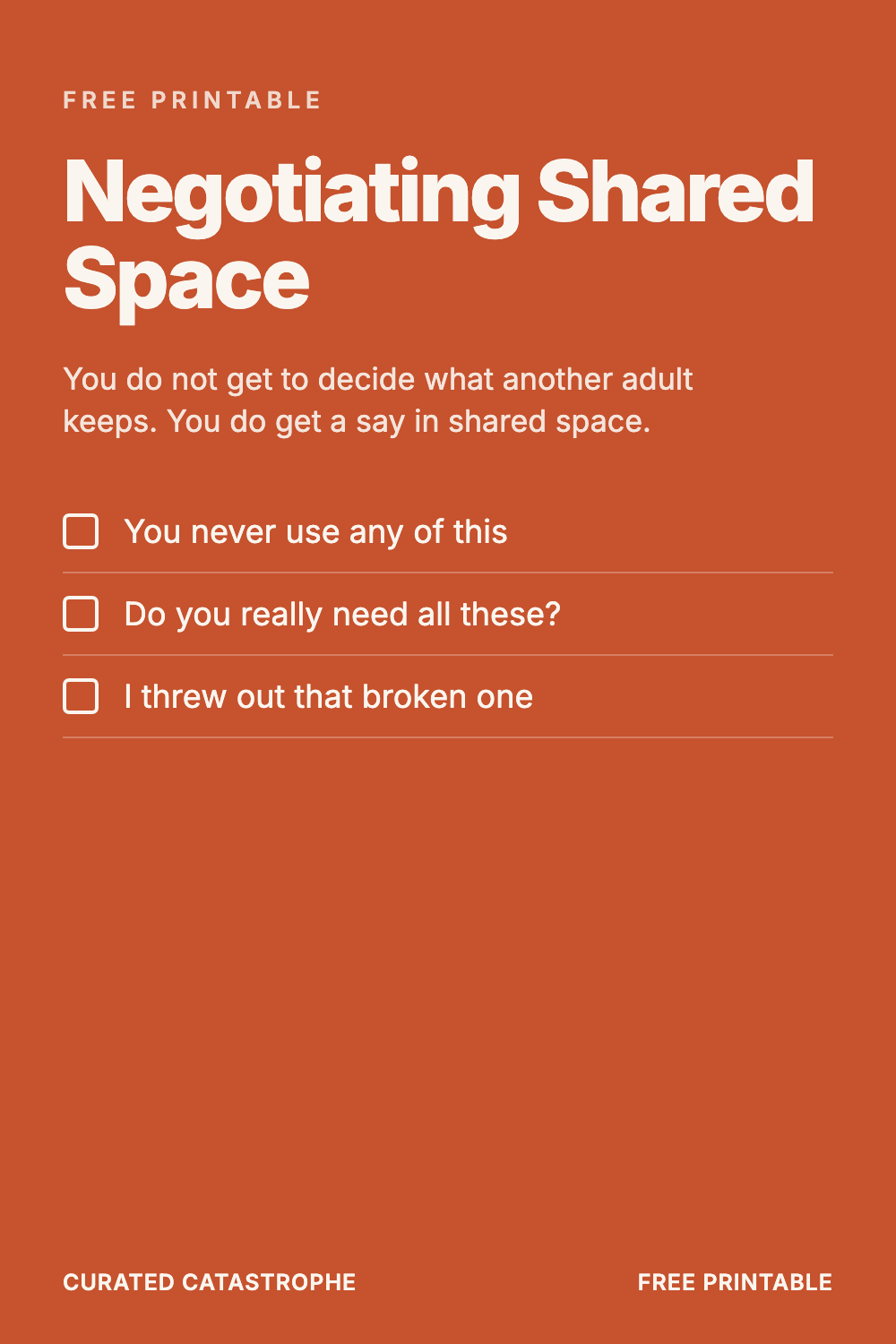
You do not get to decide what another adult keeps. You do get a say in shared space.
That distinction is the whole thing. Volume is negotiable, content is not. "Your books can have these two shelves" is reasonable. "You do not need all these books" is not, and it will cost you far more than the shelf space.
Throwing away another adult's things without asking is the fastest way to end the conversation permanently. Even when you were right about the object, you were wrong about the method, and they will remember the method.
Start with your own things, visibly
This sounds like a trick and it is not. It is the only opening move that works.
Clear your own wardrobe, your own shelf, your own side of the garage, and say nothing about theirs. Two things happen: the pressure comes off, and the difference becomes visible without anyone being told about it.
People are far more likely to declutter after watching somebody else do it than after being asked to. Leading with a request produces defensiveness; leading with an example does not.
Negotiate containers, not items
Agree the space, then let them fill it however they like.
- "The loft is getting cleared. You have these four boxes, I have four, the rest goes"
- "This cupboard needs to hold the vacuum. Can the hobby things move to the shelf?"
- "One shelf each in the bathroom"
A container is a limit somebody can meet on their own terms, which makes it feel like autonomy rather than judgement. A list of specific objects is a series of individual arguments.
What to actually say
The wording matters more than it should, because most rows here are about tone rather than content.
Works
- "I need the hall clear because of the buggy. Where should these go?"
- "Can we agree how much space the collection gets?"
- "I am not going to touch your things. Can you go through this box by Sunday?"
Starts a row
- "You never use any of this"
- "Do you really need all these?"
- "I threw out that broken one, you did not need it"
The first set names your need and leaves the decision with them. The second set passes judgement on their choices, and that is what gets defended.
Children are different, but not completely
You do have authority here, and you should still use it carefully.
Do the obvious rubbish without an audience: broken things, incomplete sets, packaging. Do the real decisions with them, and accept that they will keep things you find inexplicable.
From about four, children can choose which things go if you set the limit: "this box needs to close". That is the same container principle, and it teaches the skill rather than just clearing the room. There is a fuller version in decluttering kids' toys.
Inherited things, and the guilt
The hardest category, because the person who owned them is usually not there to release you.
Two things help. First, nobody left you an object in order to burden you with storing it. Second, if you are keeping something for a sibling or a child, ask them. A surprising amount of inherited clutter is being stored by two people who each think the other wants it.
The rest belongs in the sentimental method: edit to the best one, photograph the rest, and do not decide anything in the first year.
When they genuinely will not
Sometimes the answer is no, and it stays no.
At that point it stops being a decluttering problem and becomes a boundary one: which spaces are shared and which are theirs. A spare room, a garage bay, a set of shelves that is not your business. That is a workable outcome, and it is a great deal better than an ongoing argument.
If the volume is genuinely affecting safety, hygiene or the ability to use the home, that is not untidiness and this page is not the right tool. Hoarding is a recognised condition with actual treatment, and approaching it as a tidying disagreement makes it worse.
What helps
- Matching boxes in a fixed number, which makes the limit visible rather than argued about.
- A shelf each, labelled, in every genuinely shared cupboard.
- One donation bag that anyone can add to, with no discussion required.
- A date in the calendar, agreed together, rather than a running commentary.
What actually helps
- Matching boxes in a fixed number
Makes the limit visible rather than something to argue about.
- Shelf labels
A shelf each, named, in every genuinely shared cupboard.
Common questions
How do I get my partner to declutter?
You do not get to decide what another adult keeps, but you do get a say in shared space. Negotiate the container rather than the contents: 'your books can have these two shelves' works, 'you do not need all these books' does not. And clear your own things first, visibly, without commenting on theirs.
Can I throw away my partner's things?
No. Throwing away another adult's belongings without asking ends the conversation permanently, and even when you were right about the object you were wrong about the method, which is what they will remember.
How do I deal with inherited clutter?
Nobody left you an object in order to burden you with storing it. If you are keeping something for a sibling or a child, ask them, because a surprising amount of inherited clutter is stored by two people who each think the other wants it. Then edit to the best one and photograph the rest.
Negotiating Shared Space
You do not get to decide what another adult keeps. You do get a say in shared space.
Download the free PDFSave this for later
Rather not decide?
Should I keep this? answers it for one object in four questions.
Keep reading
- Decluttering
Decluttering Sentimental Items Without Regret
The rules that work everywhere else fail here. Sentimental things need editing rather than culling, and a different set of questions.
- Decluttering
How to Declutter Your Whole House Without Losing a Weekend
A room-by-room decluttering plan in 30-minute sessions, with a decision rule that stops you putting everything back.
- Decluttering
How to Stop Clutter Coming Back After You Declutter
Decluttering once achieves nothing on its own. The four habits that stop everything creeping back, and why most maintenance advice is unsustainable.