Decluttering
Decluttering Kids' Toys Without a Meltdown (Theirs or Yours)
How do you declutter toys without upsetting your child?
Do the first pass without them there, removing only broken items, incomplete sets, party bag toys and duplicates. None of it is missed. Involve them later, with two or three items, and never near a birthday.
Toys expand to fill any house, and the standard advice, involving your child thoughtfully choosing what to donate, works in approximately zero real households.
This is a staged method that reduces volume substantially without a scene.
Stage one: the invisible cull, without them there
Do this while they are out. It is not deceptive; it is proportionate. A four-year-old cannot meaningfully consent to a decision about ninety objects, and asking them to is how you end up keeping all ninety.
Remove, without discussion:
- Anything broken. No repairs pile. It is not going to be repaired.
- Incomplete sets and puzzles with missing pieces.
- Fast food toys and party bag contents, which nobody has ever missed.
- Anything clearly outgrown, two or more years below their current age.
- Duplicates. Three toy cars of the same type become one.
This alone usually removes a third of the volume, and none of it will be noticed.
Stage two: the box in the loft
For anything you are unsure about, put it in a box out of sight for eight weeks.
If it is not asked for in eight weeks, it goes, and you do not need to have a conversation about it. If it is asked for, it comes back, and you have learnt something real about what they actually play with rather than what you assume.
Stage three: rotation, which is the actual solution
The reason toys feel overwhelming is rarely the total number. It is the number available at once.
- Divide the remaining toys into three or four sets.
- One set out at a time. The rest in the loft, garage or under a bed.
- Swap every three or four weeks, or when interest visibly drops.
Children play longer and more deeply with fewer options, and the returning set gets received like new toys. This is the single most effective thing in this article and it involves getting rid of nothing.
Stage four: involving them, properly
Now they can be involved, because the decisions left are small enough to be manageable.
- Ask them to choose things to give to children who do not have many, which lands far better than "throw away".
- Two or three items only, not a whole room.
- Never do it near a birthday or Christmas, when they are primed to be acquisitive.
- Let them keep something you think is rubbish. Winning every item is not the goal.
Managing the inflow
The real problem is usually not the toys in the house but the rate of arrival.
- Ask relatives for experiences or consumables rather than objects. Most are relieved to be told.
- One in, one out at birthdays and Christmas, done as a pre-event sort while excitement is high.
- A permanent donate box somewhere accessible, so removal is continuous rather than an annual ordeal.
What helps
- Clear stackable boxes with lids for the rotation sets, labelled by contents rather than category.
- Open shelving with baskets rather than a toy box. A deep toy box means everything at the bottom is functionally lost.
- Photographs on the front of baskets for pre-readers, so tidying up is something they can actually do unaided.
- A jigsaw and small-parts bag system, zip bags for each puzzle, which prevents the piece-loss that kills sets.
What actually helps
- Clear stackable boxes with lids
For the rotation sets, labelled by contents rather than category.
- Open shelving with baskets
A deep toy box means everything at the bottom is functionally lost.
- Zip bags for puzzles and small parts
Prevents the piece-loss that kills sets.
Common questions
How do you declutter toys without upsetting your child?
Do the first pass without them there, removing only broken items, incomplete sets, party bag toys and duplicates. None of it is missed. Involve them later, with two or three items, and never near a birthday.
What is toy rotation and does it work?
Dividing toys into three or four sets and having one out at a time, swapping every few weeks. Children play longer and more deeply with fewer options, and the returning set is received like new toys.
How do you stop toys accumulating?
Ask relatives for experiences rather than objects, apply one in one out at birthdays and Christmas, and keep a permanent donate box somewhere accessible so removal is continuous rather than an annual ordeal.
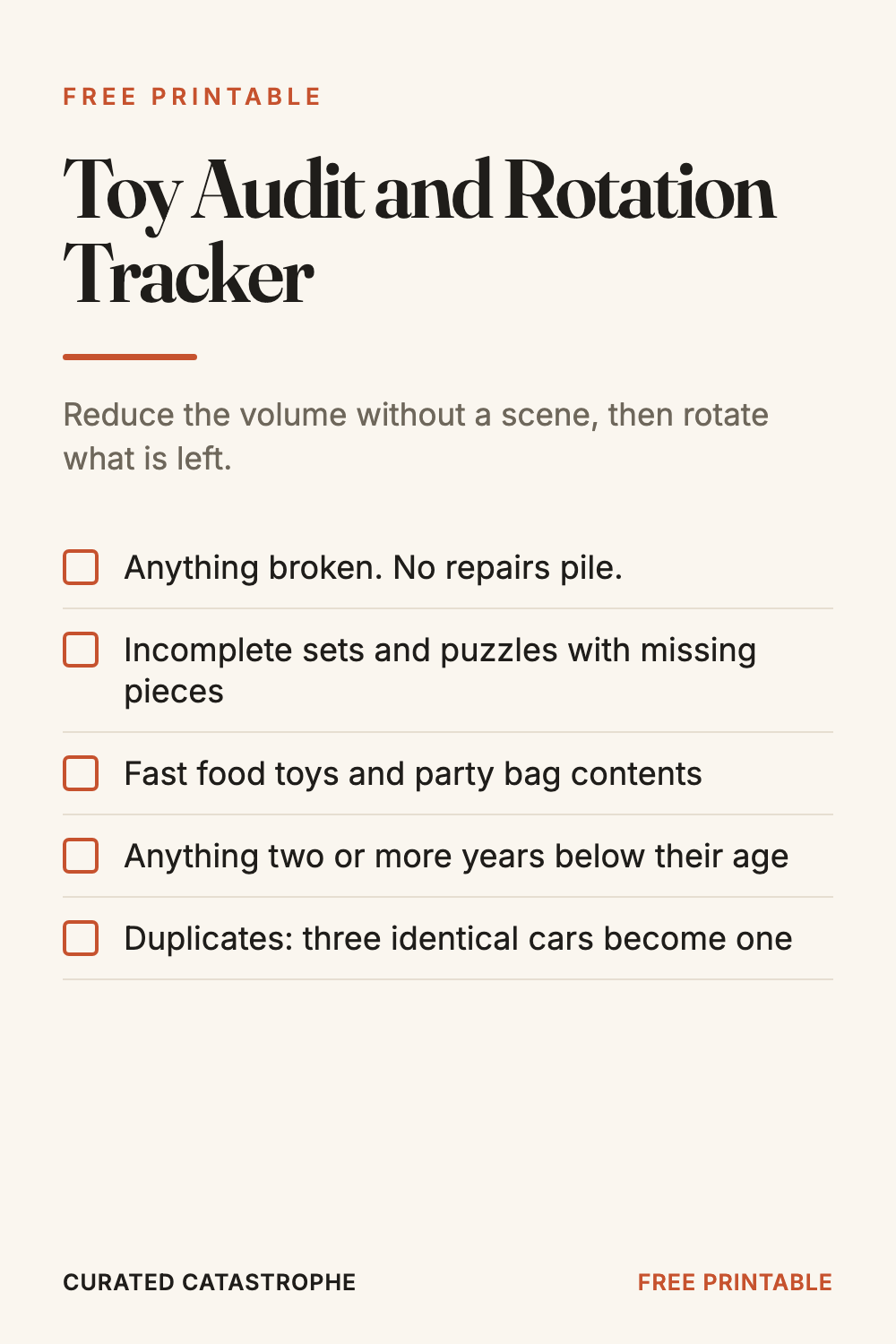
Toy Audit and Rotation Tracker
Reduce the volume without a scene, then rotate what is left.
Download the free PDFSave this for later
Rather not decide?
Should I keep this? answers it for one object in four questions.
Keep reading
- Decluttering
Back to School Home Organization: The Five Systems That Hold
The five systems that stop school mornings falling apart, set up in an afternoon and maintained in ten minutes a week.
- Decluttering
Shared Bedroom Storage for Two Children
Two children, one room, and half the storage each. The systems that reduce arguments rather than just looking tidy.
- Decluttering
Closet Organization That Survives Past February
How to organise a wardrobe so it stays organised, including the hanger trick and why matching hangers matter more than you would think.