Decluttering
Closet Organization That Survives Past February
What is the backwards hanger trick?
Turn every hanger backwards. When you wear something, hang it back the normal way. After six months, anything still backwards has objectively not been worn, which removes the guessing entirely.
Wardrobe organisation has the shortest half-life of any home project. It looks immaculate on the day and reverts within about six weeks, because most methods optimise for how it photographs rather than how it survives a Tuesday morning.
The difference between a wardrobe that lasts and one that does not is almost entirely about friction: how easy it is to put things back, not how nice it looks when everything is away.
Step one: empty it, but only one category at a time
Do not empty the whole wardrobe onto the bed. That is the standard advice and it is how people end up at 6pm surrounded by clothing, exhausted, shoving it all back.
One category at a time. All the jumpers, decide, done. Then all the trousers. You can stop between categories without leaving a disaster behind, which means you can actually do this over three evenings.
Step two: the three questions
For each item, in order:
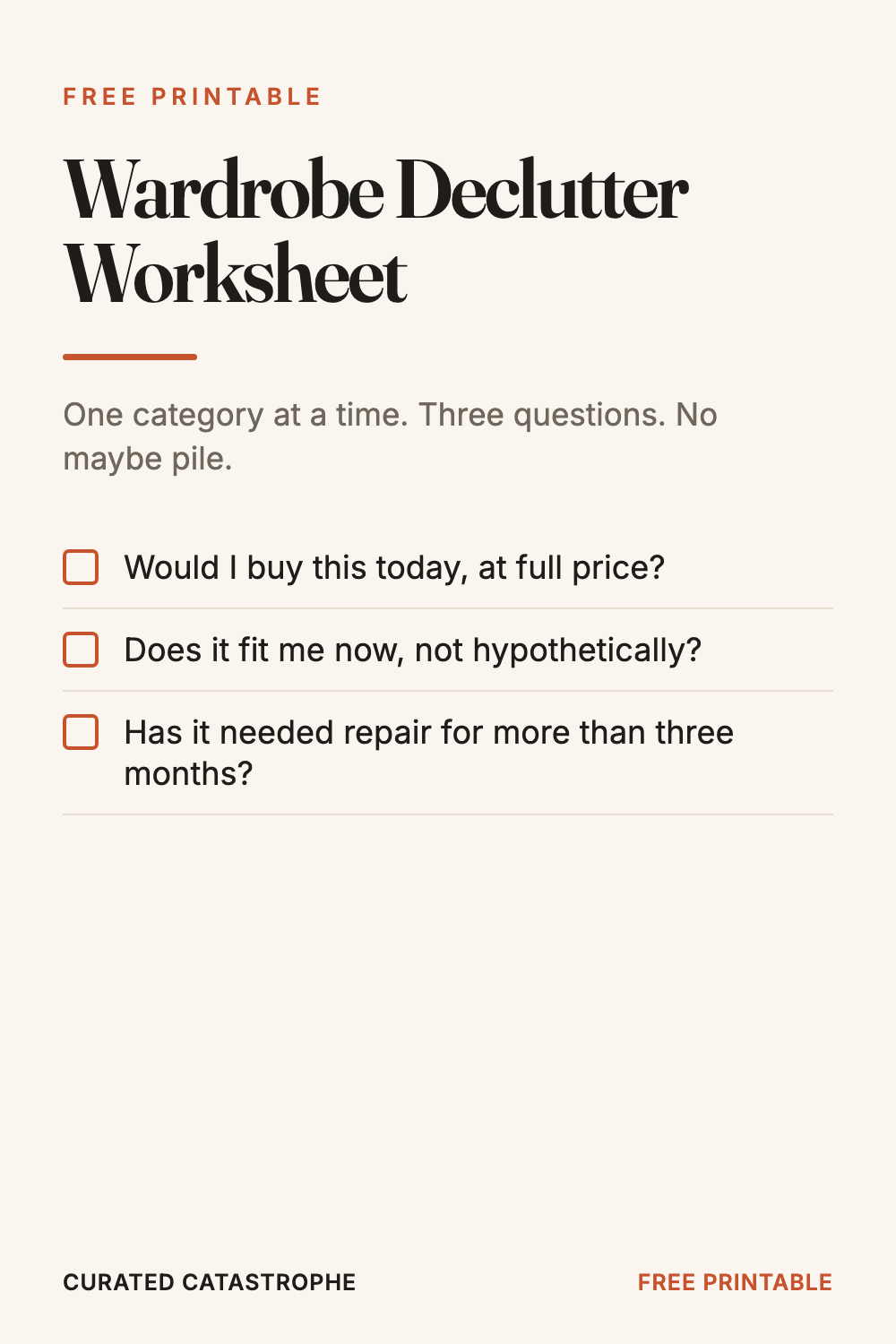
- Would I buy this today, at full price?
- Does it fit me now? Not at a hypothetical future weight, and not with the right underwear you do not own.
- Has it needed repairing for more than three months? If so, you are not going to repair it.
Anything that fails is out. No third pile of maybes, because the maybe pile is just deferral wearing a disguise.
Step three: the hanger trick, for everything you were unsure about
Turn every remaining hanger backwards. When you wear something and hang it back, turn the hanger the right way.
In six months, everything still backwards has objectively not been worn. No guessing, no self-deception, no arguing with yourself about the dress you are definitely going to wear.
This is the single most useful thing in this article. It costs nothing and it removes the entire problem of not knowing what you actually wear.
Step four: organise for putting away, not for looking
This is where most systems fail. Consider what happens when you are tired:
- Hang more than you fold. Folding is a decision and a skill; hanging is neither. Anything that gets folded badly should be hung.
- Group by type, then colour within type. Not colour first. You get dressed thinking "jumper", not "navy".
- Put the most-worn things at eye level and within easy reach. Obvious, almost never done.
- Leave a gap. A wardrobe packed to capacity is one where putting something away requires force, and that is exactly when things end up on the chair instead.
- One shelf deliberately empty. It absorbs the overflow that would otherwise become a pile.
Step five: the chair
Every bedroom has one. The chair, the exercise bike, the corner of the bed where the worn-but-not-dirty clothes live.
Stop fighting it. It exists because there is a genuine gap in the system: clothes that are not clean enough to put away and not dirty enough to wash. Give that category an actual home. A hook on the back of the door, a small basket, a single dedicated rail. The pile is not a discipline failure, it is a missing category.
What helps
- Matching slimline velvet hangers. This sounds like an aesthetic choice and is actually a capacity one: they take up roughly half the rail space of the mixed plastic and wire collection most people have, and clothes do not slide off them onto the floor.
- Shelf dividers for stacks of folded jumpers, which stop the stack becoming an avalanche the moment you take one from the middle.
- Clear drop-front shoe boxes, so you can see and reach shoes without unstacking.
- Slim hanging shelves for the top of the wardrobe, for the seasonal things you need out of the way but not out of the house.
- A door hook or small rail for the not-quite-dirty pile.
Note the order: hangers first. If you buy one thing, buy the hangers, because the space you gain is what makes everything else possible.
Maintaining it
- One in, one out, applied to clothing only. It works here because clothing is the category where the rule is easiest to follow.
- The backwards hangers, permanently. Once a year, look at what has not turned round.
- A donate bag living in the bottom of the wardrobe. When it is full, it goes. No project, no sorting day, no decision about when to deal with it.
What actually helps
- Matching slimline velvet hangers
A capacity choice, not an aesthetic one: roughly half the rail space of mixed hangers.
- Shelf dividers
Stop the jumper stack becoming an avalanche when you take one from the middle.
- Clear drop-front shoe boxes
See and reach shoes without unstacking.
- A door hook or slim rail
For the not-quite-dirty pile. It is a missing category, not a discipline failure.
Common questions
What is the backwards hanger trick?
Turn every hanger backwards. When you wear something, hang it back the normal way. After six months, anything still backwards has objectively not been worn, which removes the guessing entirely.
Why does wardrobe organisation never last?
Because most methods optimise for how it photographs rather than how easy it is to put things back. Hanging more than you fold, and leaving a gap on the rail, is what stops clothes ending up on the chair.
What should you do about the pile of worn-but-not-dirty clothes?
Give it an actual home: a hook, a small basket or a single dedicated rail. The pile is a missing category, not a discipline failure, so it reappears until the category exists.
Wardrobe Declutter Worksheet
One category at a time. Three questions. No maybe pile.
Download the free PDFSave this for later
Rather not decide?
Should I keep this? answers it for one object in four questions.
Keep reading
- Decluttering
Kitchen Organization for Kitchens That Are Too Small
How to organise a small kitchen around how you actually cook, including the zone method and the appliances worth losing.
- Decluttering
Home Office Organization for Desks in the Corner of a Room
Organising a working setup when you do not have a spare room, including how to make a desk stop being visible in the evening.
- Decluttering
Back to School Home Organization: The Five Systems That Hold
The five systems that stop school mornings falling apart, set up in an afternoon and maintained in ten minutes a week.