Decluttering
Kitchen Organization for Kitchens That Are Too Small
How do you organise a very small kitchen?
By zones: prep, cook, wash and store. Things live where they are used rather than where they fit, so getting what you need takes one step and one cupboard door.
Small kitchen advice usually amounts to "use vertical space" and a photograph of a kitchen that is not small. Useful storage in a small kitchen is less about clever products and more about being ruthless with what earns a place.
The organising principle is zones: things live where they are used, not where they fit.
The four zones
Almost everything in a kitchen belongs to one of these. Work out where each zone physically is in your kitchen, then move things to match.
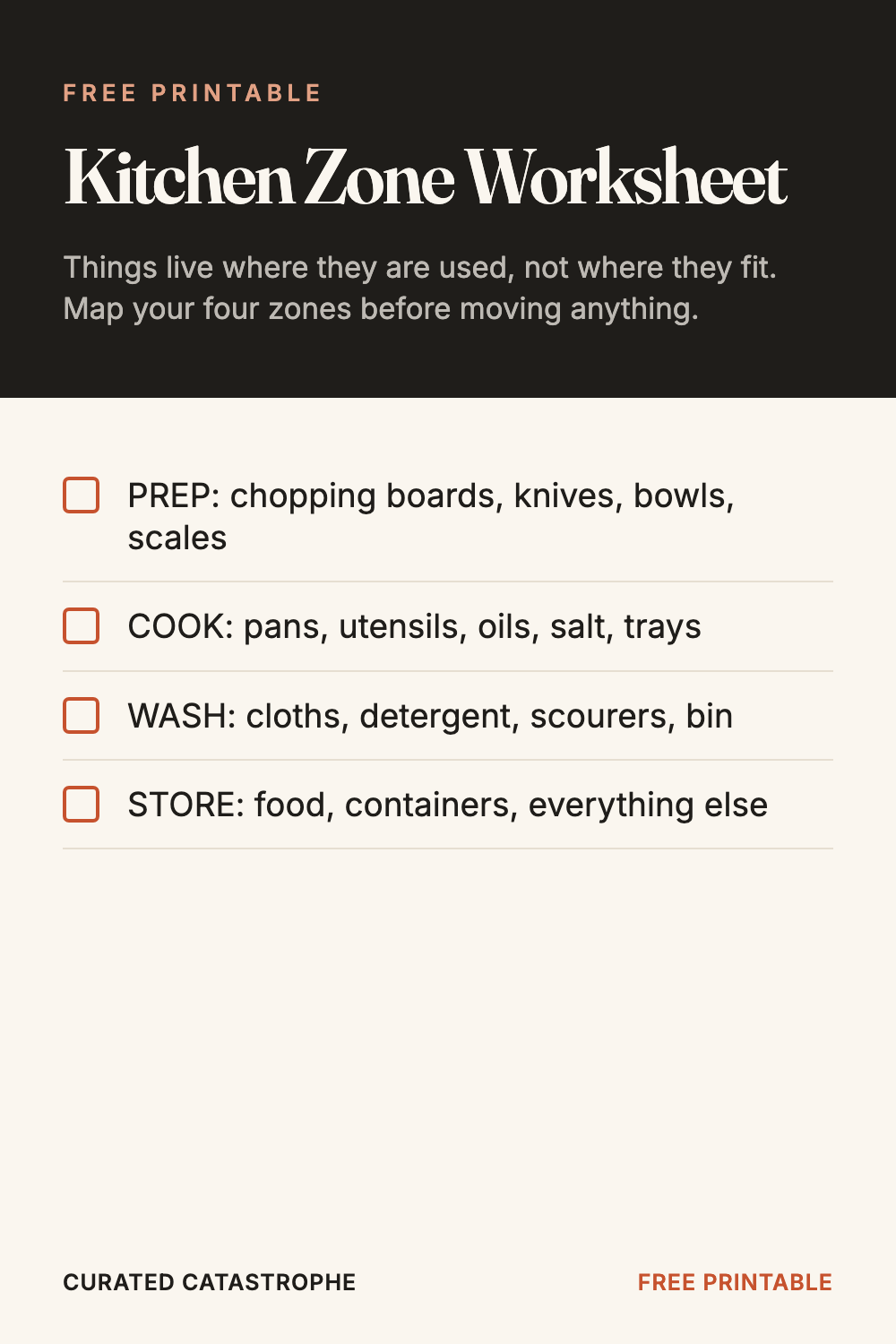
- Prep. Chopping boards, knives, mixing bowls, scales. Should be nearest your main clear worktop.
- Cook. Pans, utensils, oils, salt, oven trays. Within arm's reach of the hob, ideally without turning around.
- Wash. Cloths, detergent, scourers, bin. Under or beside the sink.
- Store. Food, containers, everything else. Furthest away is fine.
The test is simple: stand where you would stand to do the job, and see how many steps and how many cupboard doors it takes to get what you need. If it is more than one of each, it is in the wrong place.
What to get rid of first
Small kitchens are almost never a storage problem. They are a volume problem.
- Duplicate utensils. You need one fish slice. There are four.
- Single-purpose appliances used less than monthly. The bread maker, the smoothie machine, the thing for the eggs.
- Mismatched containers and orphan lids. Match every lid to a base. Bin everything unmatched, and it will be about a third of them.
- Mugs. Everybody has roughly triple the mugs they need, and mugs take up prime shelf space.
- The chipped and the never-used crockery kept "in case", for a number of guests you do not have.
- Novelty gadgets received as gifts. Donate them unopened.
Do this before buying a single storage product. Half the small kitchen problem disappears here.
Making the space work
- Go up. Shelf risers double the usable height of a cupboard, which is where most of the wasted space is.
- Use the doors. The inside of cupboard doors is genuinely free space, good for foil, cloths and small tools.
- Get things off the worktop. Worktop is the scarcest resource in a small kitchen. A wall magnet strip for knives and a rail for utensils buys back a surprising amount.
- Deep drawers beat deep cupboards every time, because you can see the back. If you can only change one thing about the kitchen itself, this is it.
- Store by frequency, not by category. The daily things go at the front at eye level, even if that separates them from their logical group.
The bit that is genuinely hard
Small kitchens force a real decision: you can own the equipment for the cooking you aspire to, or you can have a kitchen that is pleasant to cook in. Very rarely both.
Most people are storing equipment for a version of themselves that cooks differently to how they actually cook. Being honest about which recipes you make in a normal month resolves about half the storage problem instantly.
What helps
- Shelf risers, the single highest-value purchase for a small kitchen.
- A magnetic knife strip, which frees worktop and keeps knives sharper than a drawer does.
- Stackable containers in one size and shape, not a mixed set. The interlocking is the point.
- A tension rod under the sink to hang spray bottles from, which frees the floor of that cupboard entirely.
- An over-sink drying rack if worktop space is the binding constraint.
- Drawer dividers, but only after you have culled the utensils, not before.
Keeping it
The failure mode in a small kitchen is always the same: something new comes in and nothing goes out, and within a month everything is back on the worktop.
One rule, applied only to the kitchen: nothing new lives on the worktop. If it cannot go in a cupboard, it does not come in. That single constraint keeps a small kitchen functional better than any amount of organising.
What actually helps
- Shelf risers
The single highest-value purchase for a small kitchen. Most cupboards are half air.
- A magnetic knife strip
Frees worktop and keeps knives sharper than a drawer does.
- Stackable containers in one size
One size and shape, not a mixed set. The interlocking is the point.
- A tension rod under the sink
Hang spray bottles and free that cupboard floor entirely.
Common questions
How do you organise a very small kitchen?
By zones: prep, cook, wash and store. Things live where they are used rather than where they fit, so getting what you need takes one step and one cupboard door.
What should you get rid of first in a small kitchen?
Duplicate utensils, containers with no matching lid, mugs, chipped crockery kept in case, and single-purpose appliances used less than monthly. A small kitchen is a volume problem more often than a storage problem.
How do you get more worktop space?
Move things off it. A wall magnet strip for knives, a rail for utensils and shelf risers inside cupboards buy back a surprising amount, because worktop is the scarcest resource in a small kitchen.
Kitchen Zone Worksheet
Things live where they are used, not where they fit. Map your four zones before moving anything.
Download the free PDFSave this for later
Rather not decide?
Should I keep this? answers it for one object in four questions.
Keep reading
- Decluttering
Closet Organization That Survives Past February
How to organise a wardrobe so it stays organised, including the hanger trick and why matching hangers matter more than you would think.
- Decluttering
Bathroom Organization When There Is No Cabinet
Storage for small bathrooms with no built-in cupboards, plus the expiry dates on toiletries nobody checks.
- Decluttering
Home Office Organization for Desks in the Corner of a Room
Organising a working setup when you do not have a spare room, including how to make a desk stop being visible in the evening.