Decluttering
Shared Bedroom Storage for Two Children
How do I organise a bedroom shared by two children?
Treat it as a territory problem first. Give each child something unambiguously theirs, a drawer or box the other may not open, their own shelf at their height, and separate clothes storage. Then split the rest by what things are: toys played with together go in shared storage.
Two children in one room is not primarily a storage problem. It is a territory problem with a storage component, and solutions that ignore that fail regardless of how good the shelving is.
Get the ownership clear and the storage becomes straightforward. Get it wrong and you will be refereeing the same argument every evening.
Give each child something clearly theirs
Not everything, but something, and it must be unambiguous.
- A drawer or box that is theirs alone, that the other genuinely may not open
- Their own shelf, at their own height
- A named hook, a named peg bag, a labelled basket
- Colour is easier than names for pre-readers, and stays useful after they can read
This matters more than the amount of space. A child with a small clearly-owned area argues far less than one with a large shared one.
Split by what things are, not by who owns them
The workable rule in most shared rooms:
- Toys that get played with together: shared, in shared storage, in the middle of the room
- Anything precious, collected or personal: their own space, and the other child does not get a vote about it
- Clothes: always separate, always. Shared clothes storage is a daily argument
Trying to divide every toy by owner is a losing battle. Dividing by type of thing is enforceable.
Layouts that work
Bunk beds free the most floor space, which is the scarce resource. Under the bottom bunk is the best storage location in the room, so use it deliberately rather than letting it become a void.
Head to head or foot to foot along one wall works when bunks are not an option, with a shared unit between the beds acting as a divider and giving each child a side.
A divider matters more as they get older, particularly with a wide age gap. A bookcase used as a partial wall, a curtain, or a tall unit gives each child a sense of their own space without building anything.
Storage at their height
The rule that determines whether children tidy up at all: if they cannot reach it, they will not put it away.
- Low, open storage for daily toys. Open bins beat anything with a lid, because a lid is one step too many
- Their clothes for tomorrow at their height, so they can dress themselves
- High shelves for adult-managed things: spare bedding, out-of-season clothes, the things you ration
- The top of the wardrobe for long-term storage, which is dead space otherwise
Different ages, different needs
The common hard case: a toddler and a school-age child sharing.
The older one needs somewhere the younger cannot reach, and this is not unreasonable of them. Small pieces, models, homework, anything precious. A high shelf or a lockable box solves most of the conflict in the room on its own, and refusing it because "you should share" guarantees the arguments continue.
The younger one needs everything reachable. Those two requirements are compatible; they just have to be planned for.
Rotation, because volume is the real problem
Two children generate roughly twice the toys in the same square metres, so volume control matters more here than in any other room.
Keep a portion boxed and out of sight, and swap every few weeks. Fewer toys out means more playing, not less, and it halves the tidying. The full method is in decluttering kids' toys.
Involve them in the decisions
Children who chose the system use it. Children who had one imposed do not, and this is consistently the difference between a room that stays workable and one that does not.
Let them pick which side, which colour, which basket is theirs. The stakes are low and the compliance gain is large. And set the limit as a container rather than a number: "your box needs to close" is enforceable without an argument about specific toys.
What helps
- Under-bed storage on wheels, which is the best space in a shared room.
- Open low bins in two colours, one per child, no lids.
- A bookcase used as a room divider, giving each of them a side.
- One high lockable box for the older child's precious things.
- Labels with pictures, so a pre-reader can put things back in the right place.
What actually helps
- Under-bed storage on wheels
The best storage location in a shared room.
- Open bins in two colours
One colour each, no lids, because a lid is one step too many.
- A bookcase as a divider
Gives each child a side without building anything.
- Picture labels
So a pre-reader can put things back in the right place.
Common questions
How do I organise a bedroom shared by two children?
Treat it as a territory problem first. Give each child something unambiguously theirs, a drawer or box the other may not open, their own shelf at their height, and separate clothes storage. Then split the rest by what things are: toys played with together go in shared storage.
How do I get children to put their toys away?
Put the storage at their height and take the lids off. If they cannot reach it they will not use it, and a lid is one step too many. Let them choose which basket is theirs, because children who chose the system use it and children who had one imposed do not.
How do you share a room between a toddler and an older child?
The older one needs somewhere the younger cannot reach for small pieces and precious things, and that is not unreasonable of them. A high shelf or a lockable box solves most of the conflict in the room. The younger one needs everything reachable, and those two requirements are compatible.
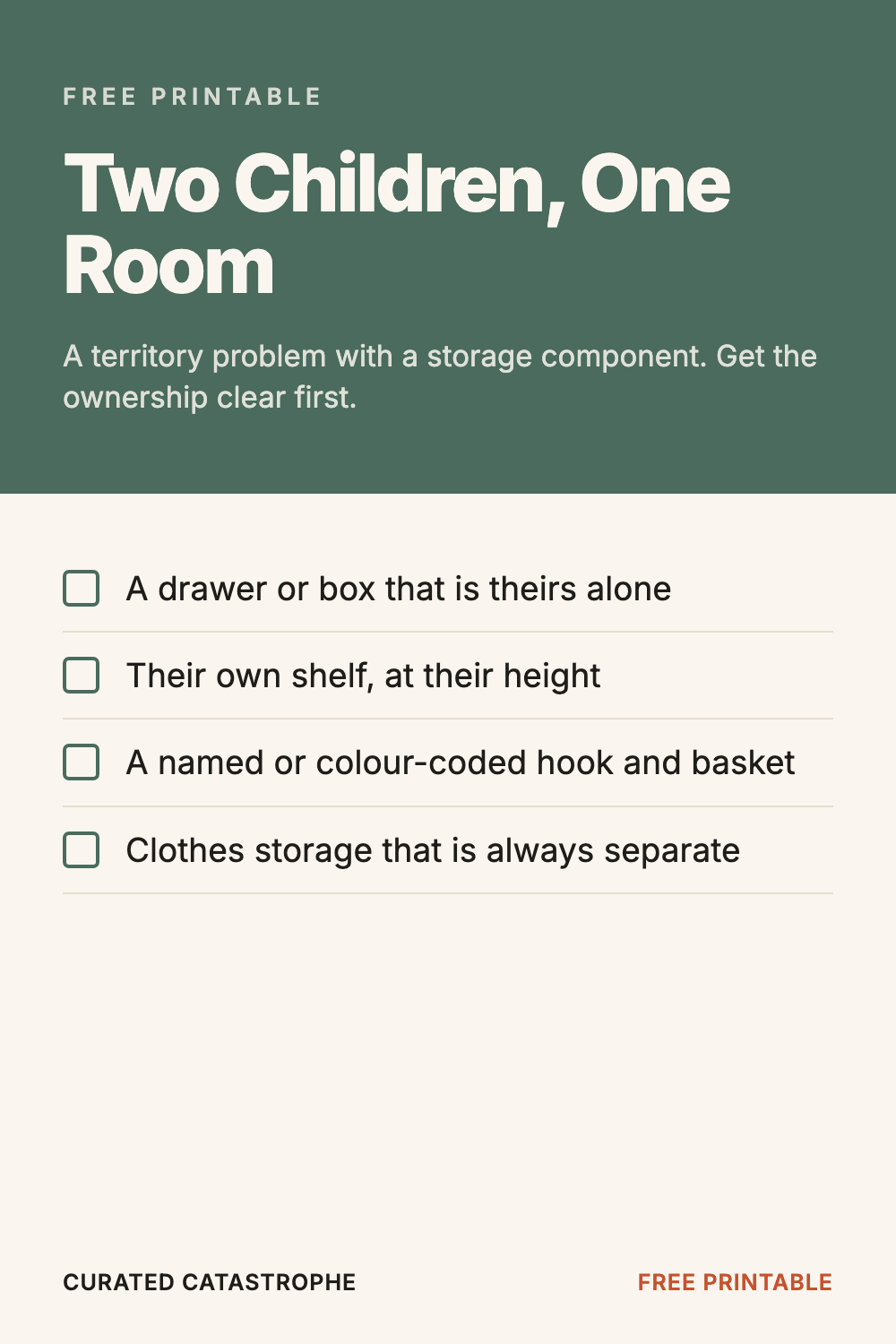
Two Children, One Room
A territory problem with a storage component. Get the ownership clear first.
Download the free PDFSave this for later
Rather not decide?
Should I keep this? answers it for one object in four questions.
Keep reading
- Decluttering
Back to School Home Organization: The Five Systems That Hold
The five systems that stop school mornings falling apart, set up in an afternoon and maintained in ten minutes a week.
- Decluttering
Decluttering Kids' Toys Without a Meltdown (Theirs or Yours)
A staged approach to reducing toy volume, including toy rotation and why you should never do the first pass with your child present.
- Decluttering
Laundry Room Organisation When It Is Actually a Cupboard
No laundry room, just a machine in a cupboard or under a worktop. Storage that works in the space around it.