Meal planning
Freezer and Pantry Inventory: Stop Buying It Twice
How do I keep track of what is in my freezer?
A tally sheet taped to the door. Take something out, cross a line off; put something in, add a line with the month. The month matters more than the exact date, because nobody writes a full date while trying to shut a freezer drawer.
Nobody means to own four bags of frozen peas. It happens because a freezer is a dark box you cannot see into, and a cupboard is a dark box with things at the back.
An inventory sounds like an enormous job. It is about twenty minutes once, and two seconds each time after, and it is the single highest-return sheet of paper in a kitchen.
Why things get bought twice
The pattern is always the same. You are in the shop, you cannot picture the shelf, and the cost of being wrong feels small. So you buy it. Then the older one moves further back.
The problem is not memory. You are being asked to recall the contents of a box you cannot see, while standing somewhere else. A list on the door removes the recall entirely.
Do it once, properly
Take everything out. Genuinely everything, one section at a time so it stays manageable.
- Bin anything unidentifiable, and anything more than a year old in the freezer
- Group what is left: meat, veg, bread, prepared meals, leftovers
- Write it on the sheet as you put it back
- Put the oldest items at the front, always
Twenty minutes for a freezer, about the same for a pantry. Do them on different days if that makes it more likely to happen at all.
Maintaining it is the easy part
A tally sheet taped to the door. Two seconds.
- Take something out? Cross a line off.
- Put something in? Add a line, with the month.
- That is the whole system.
The month matters more than the exact date. "Feb" tells you everything you need to know a year later, and nobody will write a full date at the moment they are trying to shut a freezer drawer.
The use-first list
Keep a short list, five lines at most, of what needs eating soonest. Stick it where you decide dinner rather than on the freezer.
That is the crucial detail. An inventory on the freezer door answers "what do we have". A use-first list where you plan answers "what should tonight be", and it is the second question that actually prevents waste. It feeds straight into the week's meal plan.
The eat-it-down week
Once a quarter, plan almost nothing and cook from what you own.
Most households are carrying between one and two weeks of dinners they have already paid for. An eat-it-down week costs nothing, empties the freezer, and makes the next inventory a five minute job rather than a twenty minute one.
It is also the fastest way to find out what you buy but never eat, which is the thing worth knowing before the next shop.
Dates that actually matter
- Freezer: most things are fine well past a year in terms of safety, but quality drops. Three months for bread, six for cooked meals, a year for raw meat is a workable rule.
- Cupboard: best-before is about quality, not safety. Dried goods are usually fine long after. Use-by, on chilled things, is the one to respect.
- Opened jars are the real risk, not sealed tins. Write the date on the lid when you open it.
What helps
- A dry-wipe sheet or laminated pocket for the door, so it survives being written on weekly.
- Freezer bags you can write on, or a roll of masking tape and a marker, which is cheaper.
- Square containers rather than round, because round ones waste roughly a third of a shelf.
- A clip-on freezer thermometer, since a freezer running warm is why things spoil early.
What actually helps
- A dry-wipe pocket or laminated sheet
Survives being written on and wiped every week.
- Freezer labels or masking tape
Tape and a marker is cheaper and works just as well.
- Square stackable containers
Round ones waste roughly a third of a shelf.
- A clip-on freezer thermometer
A freezer running warm is why things spoil early.
Common questions
How do I keep track of what is in my freezer?
A tally sheet taped to the door. Take something out, cross a line off; put something in, add a line with the month. The month matters more than the exact date, because nobody writes a full date while trying to shut a freezer drawer.
How long does food actually last in the freezer?
Most things stay safe well past a year, but quality drops. A workable rule is three months for bread, six for cooked meals and about a year for raw meat. Opened jars in the cupboard are a bigger risk than sealed tins, so write the date on the lid when you open one.
What is an eat-it-down week?
A week where you plan almost nothing and cook from what you already own. Most households are carrying one to two weeks of dinners they have already paid for, so it costs nothing, empties the freezer, and shows you what you buy but never eat.
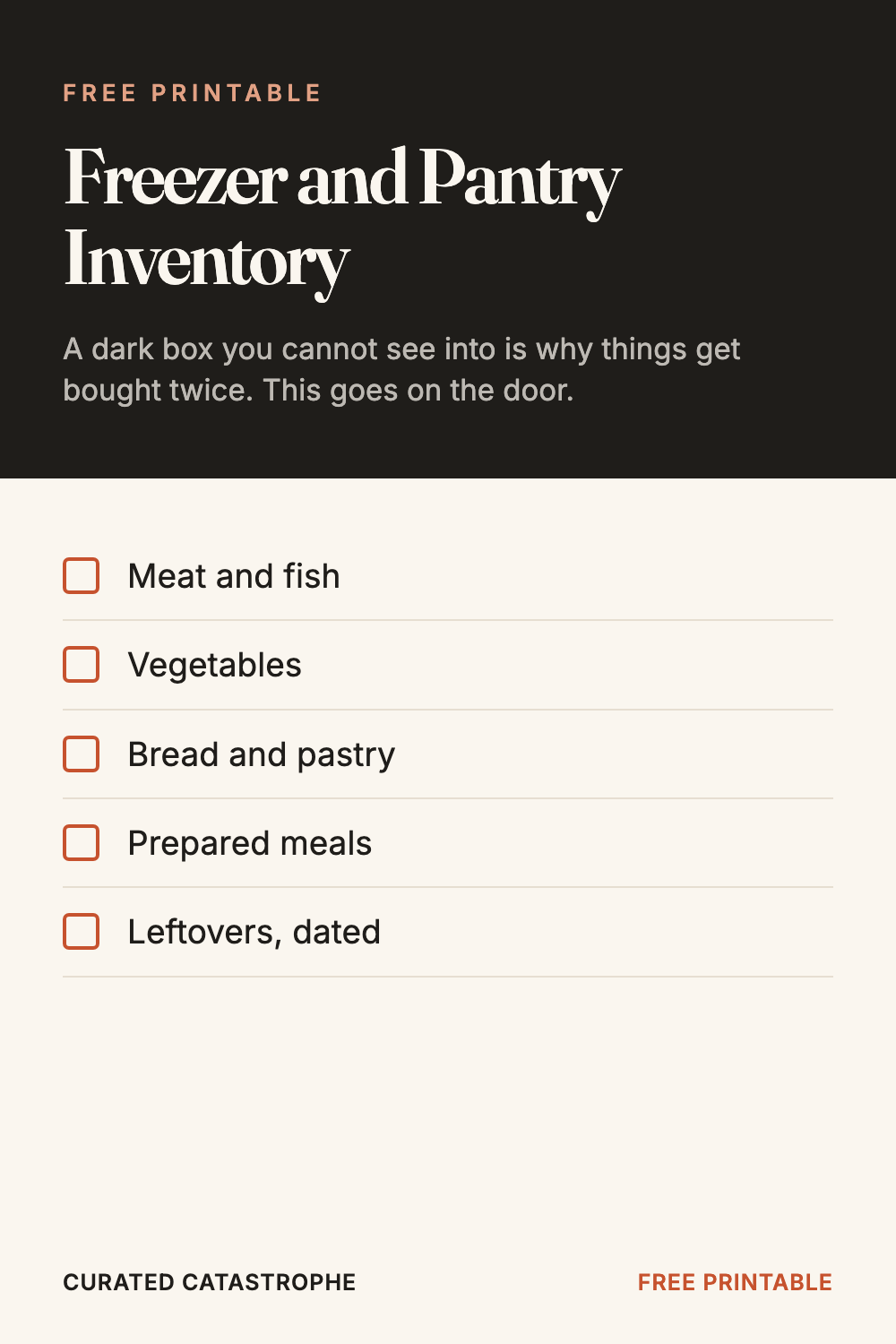
Freezer and Pantry Inventory
A dark box you cannot see into is why things get bought twice. This goes on the door.
Download the free PDFSave this for later
Rather not decide?
What's for dinner? names the kind of dinner tonight is, at half past five.
Keep reading
- Meal planning
Batch Cooking Without a Chest Freezer
Most batch cooking advice assumes a garage and a second freezer. This assumes the drawer under your fridge.
- Meal planning
The Grocery List That Matches How You Actually Shop
Sorted by where things are in the shop, not by when you thought of them, which is why you stop doubling back.
- Meal planning
What to Keep In for the Night Nothing Is Planned
A short list of things that turn into dinner on their own, so the unplanned night stops becoming a takeaway by default.