Meal planning
How to Meal Plan When You Hate Meal Planning
How do I meal plan if I hate meal planning?
Stop trying to invent thirty dinners. Write down the six meals you already cook, give each day of the week a type rather than a specific dish, and plan five nights instead of seven. The point of a plan is not variety, it is moving one decision away from half past five in the evening.
Almost nobody abandons meal planning because it does not work. They abandon it because the version they tried was a project: a blank grid, thirty slots, and an implied instruction to invent a month of dinners on a Sunday afternoon.
That is not a plan. That is homework.
The version that survives is much smaller and much more boring, and it rests on one fact: you already know how to cook about six things, and your household would happily eat them again.
The deciding is the work
Cooking is not the hard part. Most weeknight dinners take twenty minutes and you could do them without thinking.
The hard part is standing in the kitchen at half past five with no decision made, tired, with everyone asking. That moment is where takeaway wins. It is not a discipline problem. It is a decision arriving at the worst possible time of day.
Every workable meal plan is really a device for moving one decision from six in the evening to some calmer moment days earlier. That is the whole mechanism. Everything else is decoration.
Start with six, not thirty
Write down the meals you actually cook. Not the ones you would like to cook. The real list is usually between six and ten, and that is completely fine.
- Six meals on rotation is a fortnight of dinners with two nights spare
- Nobody notices repetition at a two-week interval, and nobody minds it at one
- New recipes go in one at a time, and only when you have the energy
The impulse to build a thirty-meal plan comes from imagining a version of yourself who finds cooking relaxing on a Wednesday. Plan for the actual Wednesday.
Give the week a shape
Rather than assigning specific meals to specific days, give each day a type. It is looser, so it survives a week going wrong.
- Monday: something from the freezer. The week has not started well yet.
- Tuesday: pasta or rice. Cheap, fast, universally accepted.
- Wednesday: the one that takes slightly longer, because midweek is when you still have it in you.
- Thursday: leftovers or a fridge raid. Deliberately, not accidentally.
- Friday: the easy one. Whatever your household's version of a treat is.
- Saturday: cook properly if you want to. Optional by design.
- Sunday: something that makes tomorrow easier. A roast, a big pot of something, a tray bake.
Now Tuesday is not "what shall we have", it is "which pasta". That is a far smaller question, and smaller questions get answered.
Plan for five nights, not seven
The single most common way a plan fails is being complete. Seven planned dinners means one cancelled evening breaks the whole thing, and a broken plan gets abandoned rather than adjusted.
Plan five. Leave two nights genuinely open. Those two absorb the takeaway, the unexpected late finish, the night nobody is hungry. The plan then bends instead of snapping.
Write it where people can see it
Not in an app nobody opens. On the fridge, on a whiteboard, on a printed sheet stuck inside a cupboard door.
Half the value is other people in the house being able to read it without asking you, which is also how somebody else occasionally starts dinner.
When it falls apart
It will, roughly the third week, usually because one bad evening turned into takeaway and the sheet stopped matching reality.
Do not restart the system. Do not build a better spreadsheet. Just write five meals for next week on a fresh sheet and carry on. A plan you restart casually every few weeks is a working plan; a plan you rebuild from scratch is one you are about to give up on.
What helps
- A magnetic whiteboard for the fridge, because the plan needs to be where the food is.
- A second freezer shelf kept deliberately half empty, so Monday's freezer meal always exists.
- Containers that stack in one size, which is what makes cooking double actually worthwhile.
- A cheap kitchen timer, so the longer Wednesday meal does not need watching.
What actually helps
- A magnetic fridge whiteboard
The plan has to live where the food is, not in an app nobody opens.
- Stacking containers in one size
One size stacks. Assorted sizes are why cooking double stops being worthwhile.
- A simple kitchen timer
So the slightly longer Wednesday meal does not need watching.
Common questions
How do I meal plan if I hate meal planning?
Stop trying to invent thirty dinners. Write down the six meals you already cook, give each day of the week a type rather than a specific dish, and plan five nights instead of seven. The point of a plan is not variety, it is moving one decision away from half past five in the evening.
How many meals should be in a meal plan rotation?
Six is enough. Six meals on rotation is a fortnight of dinners with two nights spare, and nobody notices repetition at a two-week interval. Add new recipes one at a time, when you have the energy, rather than building a thirty-meal plan for a version of yourself who finds cooking relaxing on a Wednesday.
Why do meal plans always fail after a few weeks?
Usually because they were complete. Seven planned dinners means one cancelled evening breaks the whole thing, and a broken plan gets abandoned rather than adjusted. Plan five and leave two nights genuinely open, so the plan bends instead of snapping.
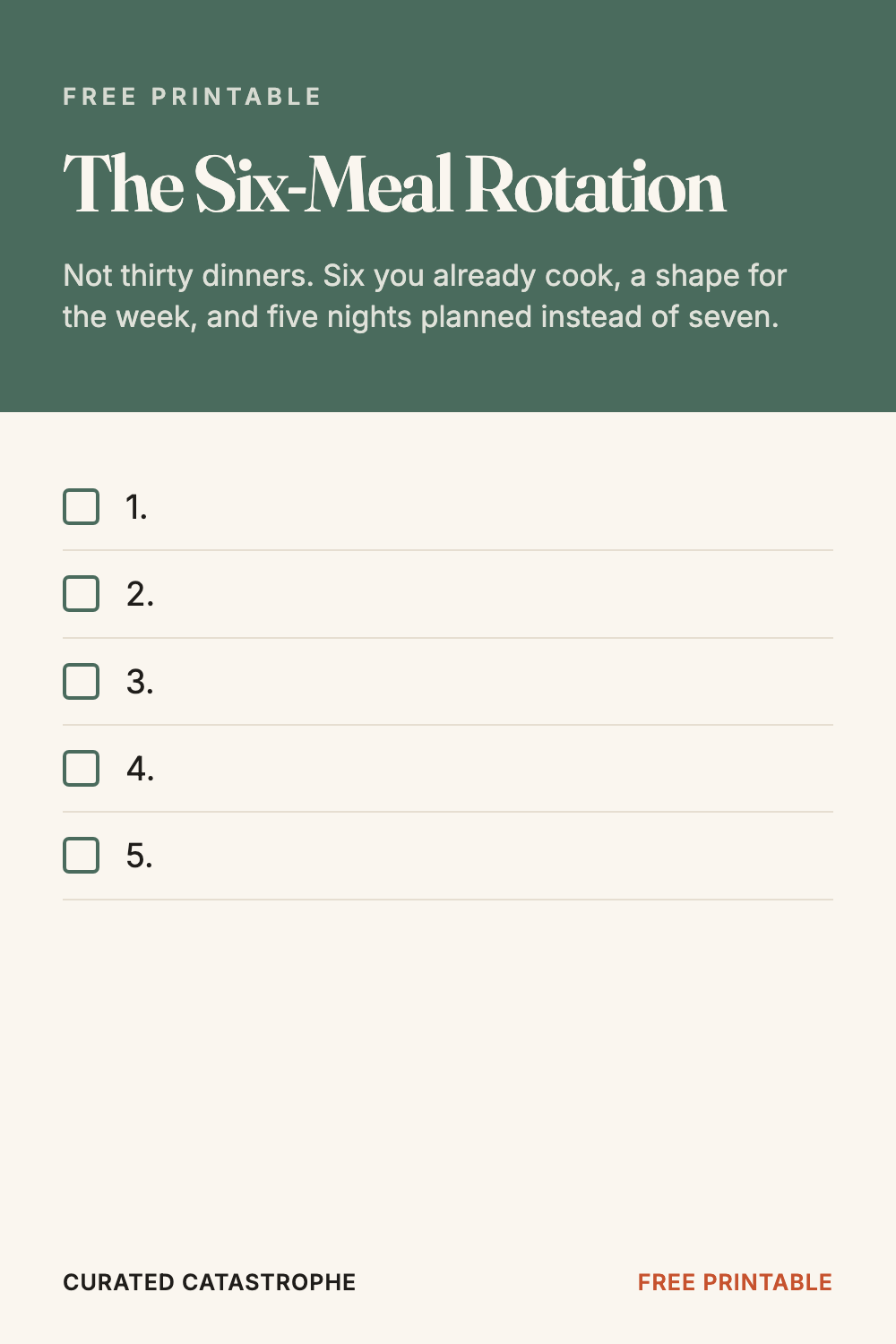
The Six-Meal Rotation
Not thirty dinners. Six you already cook, a shape for the week, and five nights planned instead of seven.
Download the free PDFSave this for later
Rather not decide?
What's for dinner? names the kind of dinner tonight is, at half past five.
Keep reading
- Meal planning
The Five Dinners Worth Learning By Heart
Not recipes. Five shapes of meal you can cook without looking anything up, which is what makes a weeknight survivable.
- Meal planning
Feeding People When the Kitchen Is Out of Action
Renovation, a broken oven, or a move. Three weeks of dinners from two appliances and a sink somewhere else.
- Meal planning
Batch Cooking Without a Chest Freezer
Most batch cooking advice assumes a garage and a second freezer. This assumes the drawer under your fridge.