Meal planning
The Five Dinners Worth Learning By Heart
How many meals should I know how to cook without a recipe?
Five is enough, and they should be shapes rather than recipes: a tray bake, fried onion with a tin and a starch, pasta with one strong flavour, eggs, and a thick soup. A recipe fails when you are missing an ingredient; a shape has slots, so it does not.
There is a difference between knowing a recipe and knowing a shape.
A recipe tells you to use 400g of one thing and 200ml of another. A shape tells you that fried onion, a tin, a starch and something green is dinner, and that it works with almost anything you happen to have.
Five shapes, held in your head, will feed a household indefinitely. They are the reason some people never seem to need a plan, and they can be learned in about a fortnight.
Why shapes beat recipes
A recipe fails when you are missing an ingredient. A shape does not, because a shape is a structure with slots rather than a list.
Cooking without looking anything up is not a talent. It is the result of having cooked the same five structures enough times that the ingredients became interchangeable.
You already have one or two of these. The exercise is to notice them, name them, and add the missing ones deliberately.
1. The one-pan tray bake
Something protein-shaped, something root-shaped, oil, heat, forty minutes and nobody watching it.
- Chicken thighs, sausages, halloumi, chickpeas
- Potatoes, squash, carrots, whatever is going soft
- The trick is size: everything cut to roughly the same size cooks at roughly the same rate
It is the most forgiving thing on this list, and the only one where walking away is part of the method.
2. Fried onion, a tin, a starch
Onion in a pan, something tinned, something to serve it on.
Tomatoes and chickpeas over rice. Coconut milk and lentils. Beans and whatever spice you own. It is twenty minutes and almost entirely from the cupboard, which is why it belongs in every rotation.
3. Pasta with one strong flavour
Not a sauce made from twelve things. One assertive thing, carried by fat.
- Garlic and chilli in oil
- Bacon or pancetta and whatever cheese is in
- Anchovy, which disappears and makes everything taste better than it should
The rule is one dominant flavour, not three competing ones. Three is how pasta ends up tasting of nothing in particular.
4. Eggs as dinner
Omelette, frittata, fried eggs on toast with something underneath. Ten minutes, always in, and socially undervalued as an evening meal.
A frittata is also the single best way to use up the vegetables that are on their last day, which makes it the natural partner to the use-first list.
5. Soup that is thicker than it should be
Onion, whatever vegetables exist, stock, blend or do not blend. Add a tin of beans or a handful of lentils and it stops being a starter and becomes dinner.
It freezes better than anything else on this list, which makes it the obvious thing to cook double of when you are already batch cooking.
The four things that finish any of them
Most home cooking tastes flat for the same reason, and it is not lack of skill. It is stopping one step early.
- Acid. Lemon, vinegar, a pickle. This is the one people miss most.
- Salt, later than you think. Season at the end as well as the start.
- Fat, at the finish. Butter, oil, yoghurt, cheese.
- Something raw or crunchy on top. Herbs, spring onion, toasted seeds, even crisps.
Any of the five shapes plus two of these four is a meal somebody would be pleased to be given.
Learning them
One a fortnight. Cook it three or four times in that period, deliberately varying what goes in, until you stop reading anything.
Do not try to learn five at once. That is a course, and you did not sign up for a course; you are trying to make Wednesday easier.
What helps
- One heavy oven tray, because a flimsy one buckles and everything slides into a corner.
- A large lidded pan that covers soup, pasta and the tin-and-onion shape without swapping.
- A pepper grinder and flaky salt, which is most of what "seasoned properly" means.
- Lemons or a bottle of decent vinegar, kept in stock as an ingredient rather than a garnish.
What actually helps
- One heavy oven tray
A flimsy one buckles and everything slides into a corner.
- A large lidded pan
Covers soup, pasta and the tin-and-onion shape without swapping pans.
- Flaky salt and a pepper grinder
Most of what "seasoned properly" actually means.
- Decent vinegar
Acid is the step people miss. Keep it as an ingredient, not a garnish.
Common questions
How many meals should I know how to cook without a recipe?
Five is enough, and they should be shapes rather than recipes: a tray bake, fried onion with a tin and a starch, pasta with one strong flavour, eggs, and a thick soup. A recipe fails when you are missing an ingredient; a shape has slots, so it does not.
Why does my home cooking taste flat?
Almost always because it stopped one step early. Four things finish nearly any dish: acid such as lemon or vinegar, salt added at the end as well as the start, fat at the finish, and something raw or crunchy on top. Acid is the one most people miss.
How do I learn to cook without following a recipe?
One shape at a time, cooked three or four times over a fortnight, deliberately varying what goes into it until you stop reading anything. Trying to learn five at once turns it into a course rather than a way of making Wednesday easier.
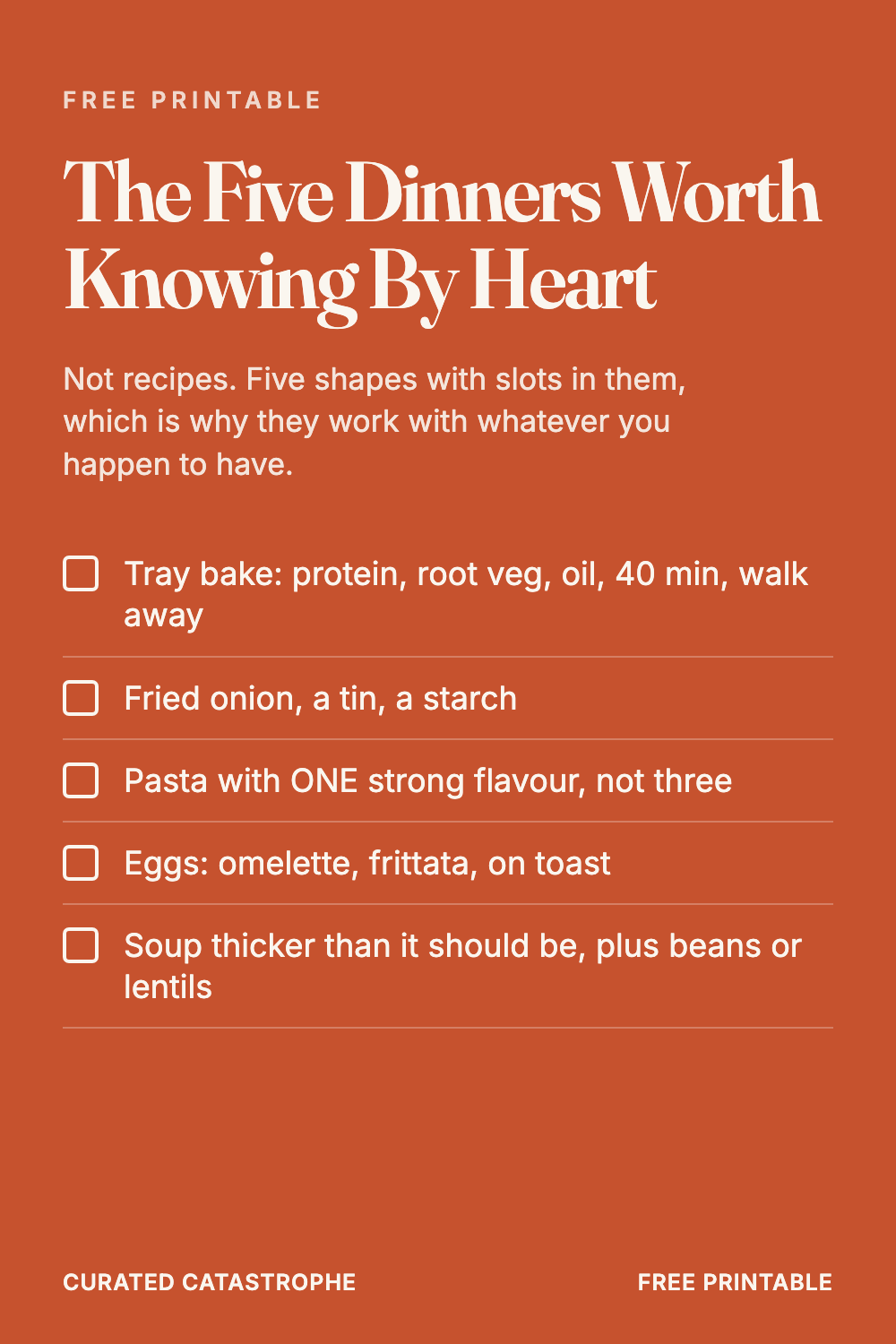
The Five Dinners Worth Knowing By Heart
Not recipes. Five shapes with slots in them, which is why they work with whatever you happen to have.
Download the free PDFSave this for later
Rather not decide?
What's for dinner? names the kind of dinner tonight is, at half past five.
Keep reading
- Meal planning
How to Meal Plan When You Hate Meal Planning
Not a spreadsheet of thirty dinners. Six meals you already cook, on repeat, with the deciding taken out.
- Meal planning
Feeding People When the Kitchen Is Out of Action
Renovation, a broken oven, or a move. Three weeks of dinners from two appliances and a sink somewhere else.
- Meal planning
Batch Cooking Without a Chest Freezer
Most batch cooking advice assumes a garage and a second freezer. This assumes the drawer under your fridge.