Meal planning
The Grocery List That Matches How You Actually Shop
What order should a shopping list be in?
The order of the shop: fruit and vegetables, bakery, chilled, freezer, cupboard, then household. Written that way you walk the shop once in a line rather than doubling back four times, which is also why things get forgotten, because you were at the other end when you remembered.
A shopping list written in the order things occurred to you is a list that sends you across the shop four times and still lets you forget the milk.
The fix is not a better memory or a cleverer app. It is sorting the list by where things are rather than by when you thought of them.
Sort by aisle, not by thought
Every supermarket is laid out in roughly the same order: produce, then bakery, then chilled, then freezer, then tins and dry goods, then household, then the till.
Write your list in that order and you walk the shop once, in a line. It sounds trivial. It removes the doubling back that turns a twenty-minute shop into forty, and it is why things get forgotten: you were at the other end of the shop when you remembered.
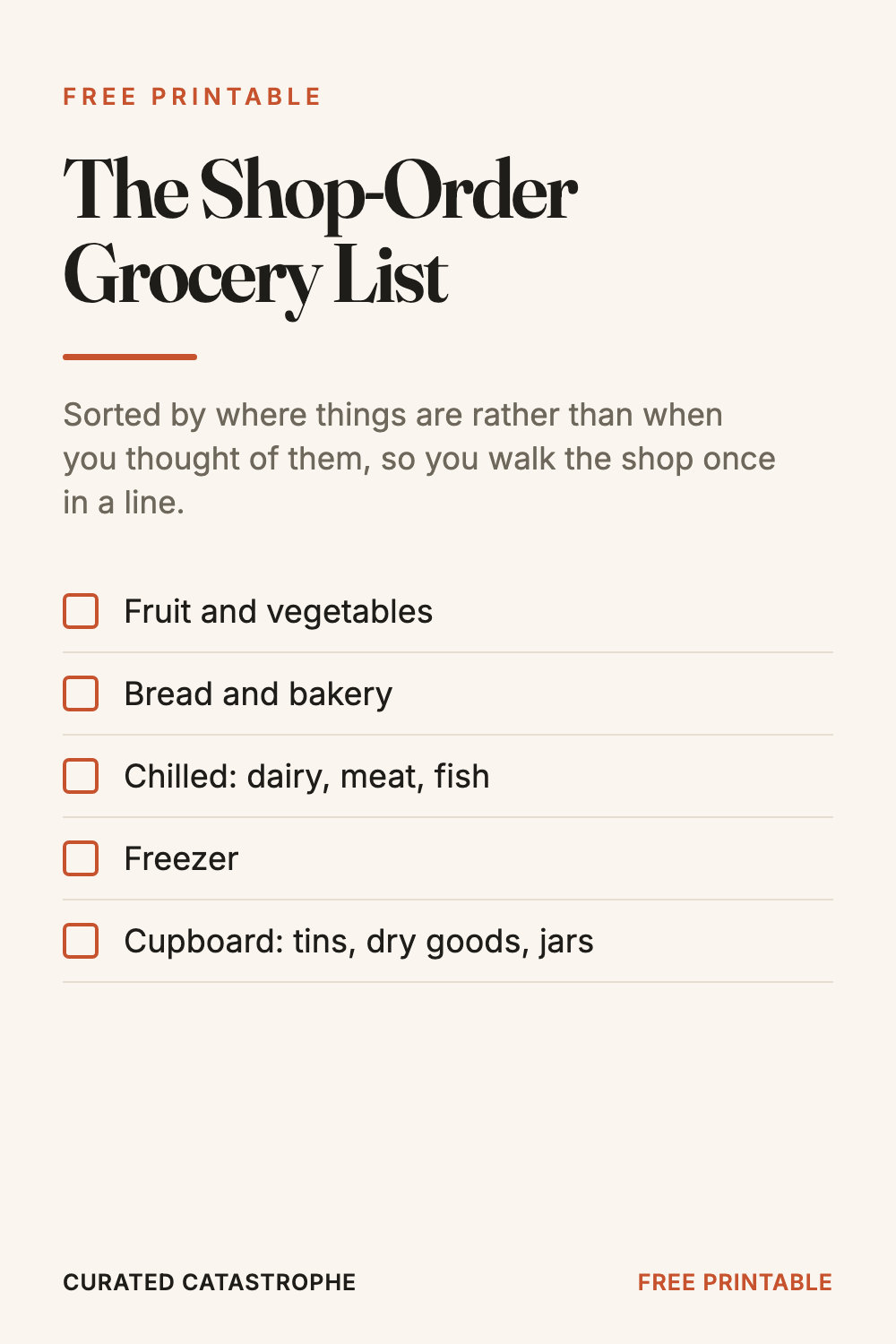
Group into six blocks and nothing more granular:
- Fruit and vegetables
- Bread and bakery
- Chilled: dairy, meat, fish
- Freezer
- Cupboard: tins, dry goods, jars
- Household and toiletries
The column people miss
Add a second column headed already have.
Before you go, check it. Most duplicate buying is not carelessness, it is not knowing what is at the back of the cupboard. Three jars of cumin is not a shopping problem, it is a visibility problem, and there is a whole guide to fixing that with a freezer and pantry inventory.
Build the list from the plan, not from the fridge
If the list comes from staring into the fridge, you buy what is missing. If it comes from the week's meals, you buy what you need.
Those produce very different trolleys. The first fills gaps; the second buys dinners.
Work through five planned meals, write the ingredients straight into the six blocks, then add the standing staples. It takes about four minutes.
The standing staples
Some things get bought nearly every time. Print them onto the sheet permanently so they are a tick rather than an act of memory.
- Milk, bread, eggs, butter
- Whatever fruit gets eaten in your house without negotiation
- One vegetable that keeps, for the night the fresh one has gone
- Coffee or tea, before it runs out rather than after
A list is not a record of what you want. It is a set of instructions for a version of you who is tired, in a shop, and would quite like to leave.
One shop, not four
Multiple small shops are where budgets quietly disappear. Every trip carries an impulse tax, and the more often you go, the more often you pay it.
One planned shop a week, with a short top-up midweek for fresh things only, beats five improvised ones on both money and time. The top-up should be a written list too, even if it is three items.
What helps
- A magnetic notepad on the fridge, so things go on the list at the moment they run out.
- A shared note on your phones, if more than one person shops, so it is one list rather than two.
- Reusable bags kept in the car, not by the front door, where they are of no use at all.
- A wallet card of the aisle order for your usual shop, which takes one visit to write and saves a minute every week after.
What actually helps
- A magnetic notepad
Things go on the list when they run out, not when you remember in the shop.
- Reusable bags that live in the car
By the front door they are of no use at all.
- A pen that stays on the fridge
The list only works if writing on it takes no effort.
Common questions
What order should a shopping list be in?
The order of the shop: fruit and vegetables, bakery, chilled, freezer, cupboard, then household. Written that way you walk the shop once in a line rather than doubling back four times, which is also why things get forgotten, because you were at the other end when you remembered.
How do I stop buying food I already have?
Add an 'already have' column and check it before you leave. Most duplicate buying is not carelessness, it is not being able to see the back of the cupboard, which is a visibility problem rather than a shopping one.
Is it cheaper to do one big shop or several small ones?
One planned shop a week, with a short written top-up for fresh things, beats several improvised trips on both money and time. Every unplanned trip carries an impulse tax, and the more often you go the more often you pay it.
The Shop-Order Grocery List
Sorted by where things are rather than when you thought of them, so you walk the shop once in a line.
Download the free PDFSave this for later
Rather not decide?
What's for dinner? names the kind of dinner tonight is, at half past five.
Keep reading
- Meal planning
What to Keep In for the Night Nothing Is Planned
A short list of things that turn into dinner on their own, so the unplanned night stops becoming a takeaway by default.
- Meal planning
Freezer and Pantry Inventory: Stop Buying It Twice
Most food waste is not forgetfulness, it is not being able to see what you own. A sheet on the door fixes it.
- Meal planning
Batch Cooking Without a Chest Freezer
Most batch cooking advice assumes a garage and a second freezer. This assumes the drawer under your fridge.