Decluttering
The Junk Drawer, Properly Sorted
How do I organise a junk drawer?
Empty it completely, wipe it out, then sort by fate rather than by type: bin, belongs elsewhere, genuinely lives here, and no idea what this is. Buy dividers only after the sort, because organising an unsorted drawer just organises the problem.
Every house has one. Usually in the kitchen, usually stiff to open, containing batteries of unknown charge, keys to nothing, a takeaway menu from a place that closed, and at least one cable nobody can identify.
The junk drawer is not a failure of organisation. Households genuinely need one place for the small, unrelated, occasionally useful things that have nowhere else to live.
The problem is not that it exists. The problem is that nothing ever leaves it.
Empty it completely
Onto a table, all of it, including the layer of grit at the bottom. Wipe the drawer out while it is empty, because it will not happen otherwise.
This takes about two minutes and is not optional. Sorting a drawer while things are still in it means the things at the back never get examined, and the things at the back are the whole problem.
Four piles, not categories
Do not start by sorting into types. Sort by fate.
- Bin. Dried-out pens, dead batteries, broken things, anything sticky.
- Belongs somewhere else. Which is most of it, and it goes to that room now, not later.
- Genuinely lives here. The short list below.
- No idea what this is. Its own pile, dealt with at the end.
The unknown pile
Be firm and be realistic. If you cannot identify an object, you are not going to use it, because using it would require knowing what it is.
Cables are the main offender. If it does not match any device currently in the house, it goes to electrical recycling. Keys that open nothing go in the bin; keys you are unsure about go on a ring with a label, in one place, and get reviewed in a year.
The unknown pile is where the guilt lives. It feels wasteful to bin something that might be useful, which is exactly how it got into the drawer, and why it will still be there in five years unless you decide now.
What actually belongs in a junk drawer
Short list. If it grows much beyond this, the drawer stops working as a drawer and becomes a box of things you cannot find.
- One roll each of tape and masking tape
- Scissors, and a small screwdriver set
- A tape measure
- Batteries, in date order, in one small box
- Superglue, and a few elastic bands
- A torch that works
- Pens that write, tested, plus a pencil
- Spare keys, labelled
Notice what is not on it: paperwork, receipts, medicine, phone cables in quantity, anything belonging to one specific person. Those all have proper homes, and the same three-way sort that works for household paperwork applies to the papers in here.
Divide it, but only after
Dividers are the last step and not the first, which is the mistake most articles on this make. Buying an organiser for a drawer you have not sorted just organises the problem.
Once it is culled, small open containers or an adjustable divider set keeps things from migrating. Batteries in one box is the single most useful division, because loose batteries are how you end up buying more of them.
Batteries and cables, specifically
The two things people do not know what to do with, which is why they stay.
- Batteries never go in household waste. Supermarkets and DIY shops have collection points, usually near the entrance. Keep a small tub for dead ones and empty it when you shop.
- Cables and small electricals go to electrical recycling, not the bin. Most councils collect small electricals, and any shop selling electricals has to take them back.
- Keep exactly one spare phone cable per device type, not eleven.
Stopping it refilling
The drawer refills because it is the path of least resistance for anything without a home.
The fix is not discipline, it is making somewhere else easier: a tray by the door for post and keys, a labelled box for the specific hobby thing, a hook for the item you keep putting down. This is the general principle behind stopping clutter coming back, applied to one drawer.
Then check the drawer twice a year. It takes five minutes once it is set up, and about twenty if you leave it five years.
What helps
- An adjustable drawer divider set, bought after the sort rather than before.
- A small battery box or tester, which removes the "is this one dead" problem entirely.
- Labelled key tags, so the unknown-key pile never rebuilds.
- A tub for dead batteries kept with the recycling, not in the drawer.
What actually helps
- An adjustable drawer divider set
Bought after the sort, never before.
- A battery tester or storage box
Removes the "is this one dead" problem entirely.
- Labelled key tags
So the unknown-key pile never rebuilds.
Common questions
How do I organise a junk drawer?
Empty it completely, wipe it out, then sort by fate rather than by type: bin, belongs elsewhere, genuinely lives here, and no idea what this is. Buy dividers only after the sort, because organising an unsorted drawer just organises the problem.
What should you keep in a junk drawer?
Tape and masking tape, scissors, a small screwdriver set, a tape measure, batteries in one box, superglue, elastic bands, a torch that works, pens you have tested, and labelled spare keys. Paperwork, medicine and quantities of cables all belong elsewhere.
What do I do with old batteries and cables?
Batteries never go in household waste; supermarkets and DIY shops have collection points near the entrance. Cables and small electricals go to electrical recycling, and any shop selling electricals has to take them back. Keep one spare cable per device type.
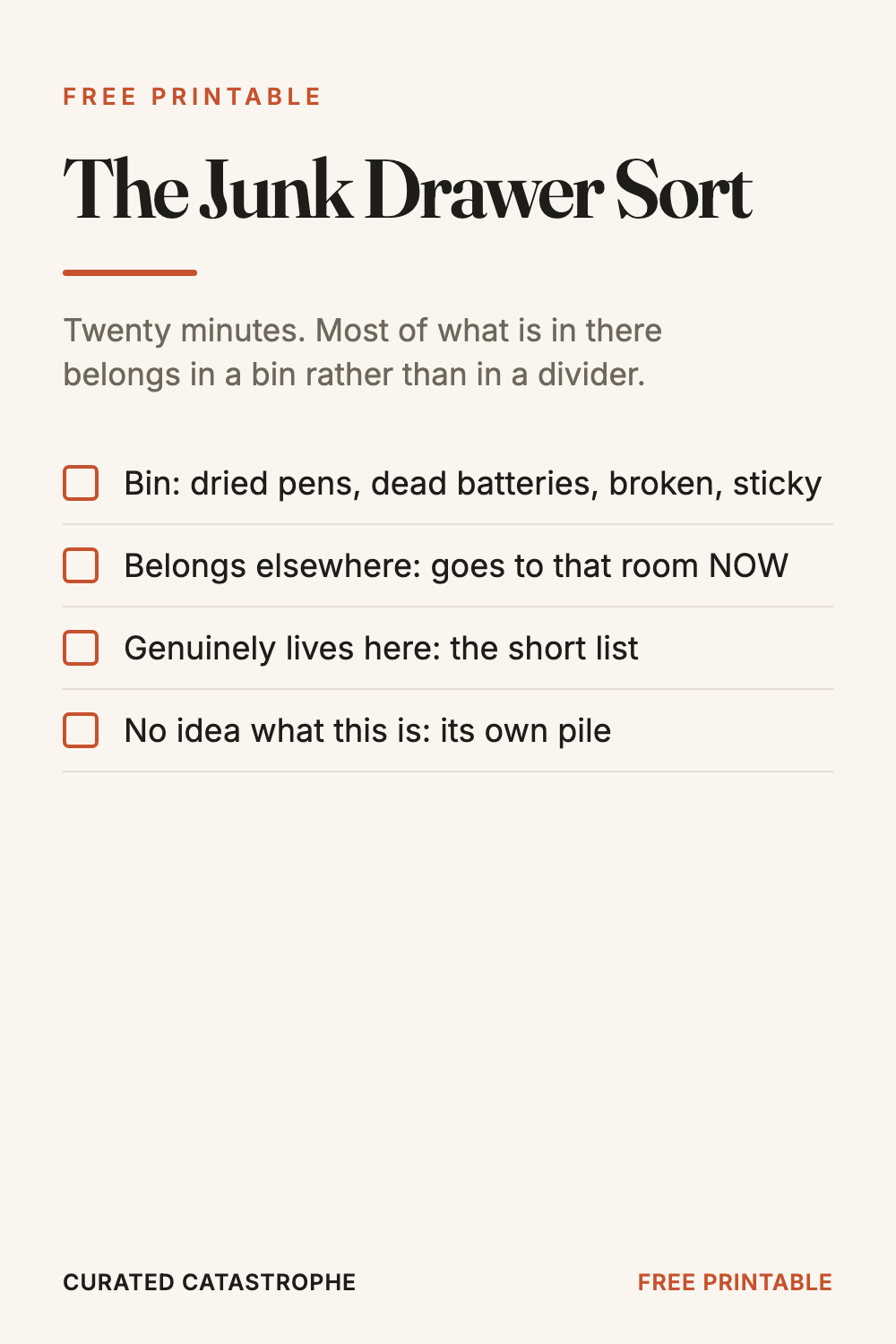
The Junk Drawer Sort
Twenty minutes. Most of what is in there belongs in a bin rather than in a divider.
Download the free PDFSave this for later
Rather not decide?
Should I keep this? answers it for one object in four questions.
Keep reading
- Decluttering
Under-Sink Organisation That Survives a Leak
An awkward wet cupboard with a pipe through the middle. Storage that works around the plumbing rather than pretending it is not there.
- Decluttering
Back to School Home Organization: The Five Systems That Hold
The five systems that stop school mornings falling apart, set up in an afternoon and maintained in ten minutes a week.
- Decluttering
Craft and Hobby Supplies: An Honest Cull
Written for people who genuinely make things. The problem is not the supplies, it is the projects you have already abandoned.